
CroCoNet (Cross-species
Comparison of Networks) is a
computational pipeline and R package for the quantitative comparison of
gene-regulatory networks across species. The approach hinges on
contrasting network variability within and across species in order to
distinguish true evolutionary divergence from technical and biological
confounders. By enabling robust network analyses, CroCoNet contributes
towards finding meaningful cross-species differences in gene regulation.
For a comprehensive description of CroCoNet and its biological
applications, please refer to the accompanying preprint
on bioRxiv.
This vignette provides a practical guide to CroCoNet using an example dataset of early primate neural differentiation. The data files for this analysis are available in the project’s Zenodo archive, under “neural_differentiation_dataset.zip”. All file paths used in the examples below are relative to this master folder.
Through this tutorial, users will learn how to:
Prepare and format input data for CroCoNet (including preprocessing and network inference)
Process networks and build the consensus network
Assign and characterize modules
Calculate module preservation scores within and across species
Quantify module conservation across all species and along specific lineages
Visualize modules using network- and tree-based representations
Input data
Experimental design
CroCoNet was designed to analyze scRNA-seq data from multiple species, with multiple replicates per species. For a meaningful analysis, the conditions, pseudotemporal trajectory and cell type composition should be as comparable across species as possible. To reliably infer networks, the dataset should in addition have sufficient expression variance across cells (several different conditions, time-series experiment over a dynamic process or a mixture of cell types).
To generate the example data, three iPS cell lines from three humans, two iPS cell lines from one gorilla and four iPS cell lines from two cynomolgus macaques were differentiated into neural progenitor cells (NPCs) over the course of nine days. Samples from six different time points were sequenced using scRNA-seq. The protocol and timeline were the same for all species to make the results comparable.
At several steps of the CroCoNet workflow, the replicates need to be matched to species. To make this possible, a data frame replicate2species has to be created that specifies which species each replicate belongs to. How this looks like for the example data is shown below:
replicate2species <- readRDS("processed_data/replicate2species.rds")| replicate | species |
|---|---|
| H1c1 | human |
| H2c1 | human |
| H3c1 | human |
| G1c1 | gorilla |
| G1c2 | gorilla |
| C1c1 | cynomolgus |
| C1c2 | cynomolgus |
| C2c1 | cynomolgus |
| C2c2 | cynomolgus |
Initial processing
The pipeline assumes that the user has already done the standard processing steps on the transcriptomic data, including mapping, QC and normalization. In addition, it is required to have a shared feature space across all species. In case of closely related species, genes can be matched by transferring the annotation of one species to the genomes of others using the tool Liftoff [1]. It is of course also possible to use orthology information or even protein language model-based macrogenes [2].
It is also recommended to perform cell type annotation and pseudotime inference if applicable. After these steps, a SingleCellExperiment (SCE) object should be created that contains the raw counts, normalized counts and metadata (including information on species, replicate, cell type assignment and inferred pseudotime).
In case of the primate differentiation dataset, we created a shared feature space by transferring the human genome annotation to the gorGor6 and macFas6 genomes via Liftoff. We performed the nornalization using scran [3], pseudotime inference using SCORPIUS [4] and cell type annotation using singleR [5] with the embryoid body dataset from Rhodes et al. [6] as the reference. We found that the pseudotime trajectories are reasonably well-aligned across the 3 species, confirming comparability.
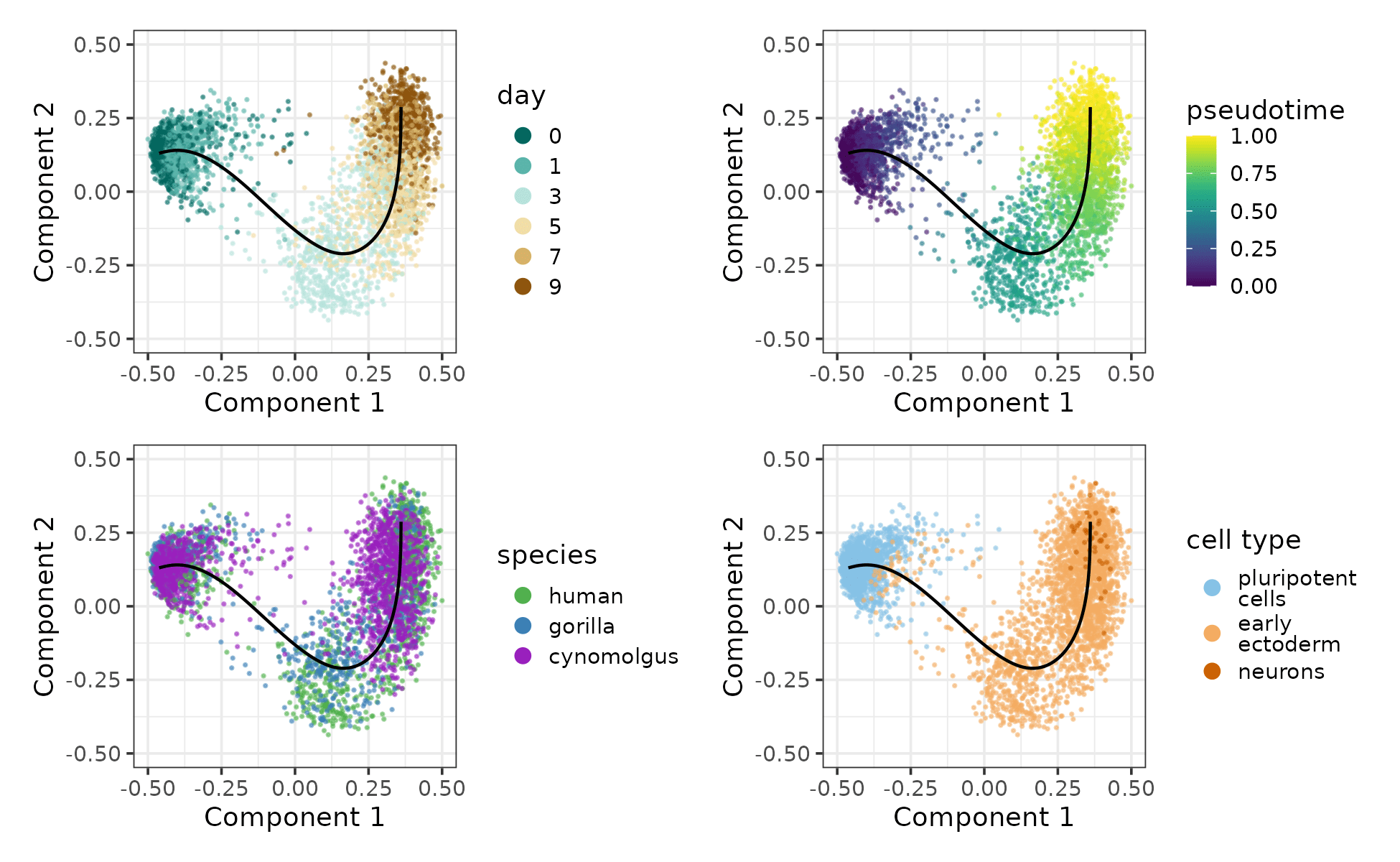
Pseudotime trajectory of the early primate neural differentiation dataset coloured by sampling day, pseudotime, species and cell type.
Network inference
Before applying the pipeline, the user must first infer co-expression networks per replicate using a method of their choice, for example GRNBoost2 [7] (metric: gradient boosting-based importance scores) or correlatePairs [3] (metric: Spearman’s correlation). The networks should not be restricted to connections between transcriptional regulators and their target genes, because CroCoNet relies also on connections between the target genes themselves.
If the replicates differ substantially in cell type composition, it is recommended to downsample them so that the proportions of cell types are consistent across replicates. This helps disentangle species-specific effects from cell type differences. It can be beneficial to create multiple downsampled versions of each replicate and run network inference on each, ensuring that valuable data are not discarded.
If the chosen network inference algorithm involves stochastic steps (as is the case for GRNBoost2), the results can be made more robust by running the algorithm multiple times on the same data with different random seeds.
The network reconstructions should be stored as TSV files where each row corresponds to an edge. There should be at least 3 columns containing 1) the 1st gene that forms the edge, 2) the 2nd gene that forms the edge, and 3) the edge weight. The TSV files should follow the naming convention nameOfReplicate.tsv (if there is a single network per replicate) or nameOfReplicate_index.tsv (if multiple network outputs are generated per replicate).
In case of example dataset, we inferred networks using GRNBoost2 with
all genes as potential regulators. We run the algorithm 10 times on the
count matrix of each replicate, producing a total of 9×10 TSV files
stored in the directory network_inference/output/.
Loading and processing the networks
In the first part of the workflow, the output files of the network inference are loaded as igraph objects, the edges are filtered and the edge weights are normalized (if desired), and finally, a phylogeny-aware consensus network is calculated across all replicates and species. If the network inference algorithm does not distinguish positively and negatively correlated gene pairs, this information can also be added at this stage.
Loading the networks as igraphs
As the first step, the TSV files containing the network reconstructions are loaded and summarized as a list of igraph [8] objects per replicate with the help of the loadNetworks function.
If there are several versions of network reconstruction per replicate due to different subsamplings or repeated runs (specified via the parameter rep), the edge weights are averaged across these versions, and a single combined igraph object is returned for each replicate. If the network inference method produces an output with directed edges, i.e. geneA-geneB and geneB-geneA can both be present (specified via the parameter directed), the edge weights inferred between the same gene pair but in opposite directions are also averaged. Edges that fall below the detection threshold in a network version/direction are assigned an edge weight of 0 for the calculation of the mean. If an edge meets the detection criteria in too few versions/directions (specified via the parameter min_occurrence), it is assigned a final weight of 0 in the corresponding replicate, regardless of its mean weight. This filtering approach helps to 1) denoise the networks and 2) decrease the computational power needed for the next steps. The steps relying on a detection threshold are not applicable to correlation-based networks.
In case of the example dataset, the 9×10 TSV files located in the network_inference/output/ directory were loaded as a list of 9 igraph objects (one network reconstruction for each of the 9 replicates). The parameter rep was set to 10 as GRNBoost2 had been run 10 times on each replicate, and the parameter directed was left at the default value of TRUE, as GRNBoost2 produces a directed output. As a result, the edge weights were averaged across the 10 runs and 2 directions for each edge and replicate. Since the parameter min_occurrece was left at its default value of 2, edges that occurred zero or one times across all runs and directions were assigned a weight of 0.
network_list_raw <- loadNetworks("network_inference/output/",
                                 replicate_names = replicate2species$replicate,
                                 rep = 10,
                                 directed = TRUE,
                                 min_occurrence = 2)
The resulting igraph objects store the weights for each edge:
| from | to | weight |
|---|---|---|
| A1BG | ACAT2 | 0.0041 |
| A1BG | ACBD4 | 0.0107 |
| A1BG | ACTR10 | 0.0187 |
| A1BG | ACVR2A | 0.0184 |
| A1BG | ADAM9 | 0.0545 |
| A1BG | ADARB1 | 0.0317 |
| A1BG | ADM5 | 0.0404 |
| A1BG | ADO | 0.0180 |
Removing gene pairs with overlapping annotations
Mapping and counting is problematic for overlapping genomic features: parts of the reads from one gene can be assigned to the other gene, leading to correlated expression profiles simply due to genomic position. This has only a marginal effect on the results of a differential expression analysis, but can cause false positive edges with very high edge weights in case of a network analysis. Such potential artefacts can be circumvented by removing all edges between genes that have overlapping annotations in the genome(s) of at least one species.
To do this, the genome annotations are needed in a list format:
gtf_list <- list(human = plyranges::read_gff("genomes/hg38.gtf"),
                 gorilla = plyranges::read_gff("genomes/gorGor6.gtf"),
                 cynomolgus = plyranges::read_gff("genomes/macFas6.gtf"))
Then the function removeOverlappingGenePairs determines the genomic positions of the network genes based on the GTFs, identifies gene pairs with overlapping annotations in each genome and removes these gene pairs from all networks:
network_list_raw_filt <- removeOverlappingGenePairs(network_list_raw,
                                                    gtf_list = gtf_list,
                                                    replicate2species = replicate2species,
                                                    gene_col = "gene_name")
During this step, the genomic distance is also added for each gene pair of the network (the distance is regarded as Inf if the two genes are located on different chromosomes):
| from | to | weight | genomic_dist |
|---|---|---|---|
| A1BG | ACAT2 | 0.0041 | Inf |
| A1BG | ACBD4 | 0.0107 | Inf |
| A1BG | ACTR10 | 0.0187 | Inf |
| A1BG | ACVR2A | 0.0184 | Inf |
| A1BG | ADAM9 | 0.0545 | Inf |
| A1BG | ADARB1 | 0.0317 | Inf |
| A1BG | ADM5 | 0.0404 | 8270693 |
| A1BG | ADO | 0.0180 | Inf |
Normalizing edge weights
Normalizing the edge weights between 0 and 1 is recommended, because it makes them interpretable as adjacencies and ensures that network concepts such as connectivity are applicable.
There are 2 approaches for the normalization implemented as part of the nornmalizeEdgeWeights function:
Unsigned network (default): Gene pairs with high negative edge weights are considered as connected as gene pairs with high positive edge weights. Therefore the negative edge weights are first replaced by their absolute values, then all edge weights are scaled by the maximum weight across all networks: where is the edge weight (adjacency) after normalization and is the edge weight before normalization. After the transformation, the adjacencies around 0 correspond to the former low positive and low negative values, while the adjacencies around 1 correspond to the former high positive and high negative values.
Signed network: Gene pairs with high negative edge weights are considered unconnected. Therefore all edge weights are transformed between 0 and 1 using a min-max normalization: After the transformation, the adjacencies around 0 correspond to the former high negative values and the adjacencies around 1 correspond to the former high positive values.
In case of the example dataset, we opted for an unsigned network:
network_list <- normalizeEdgeWeights(network_list_raw_filt,
signed = FALSE)| from | to | weight | genomic_dist |
|---|---|---|---|
| A1BG | ACAT2 | 0.000048 | Inf |
| A1BG | ACBD4 | 0.000127 | Inf |
| A1BG | ACTR10 | 0.000222 | Inf |
| A1BG | ACVR2A | 0.000218 | Inf |
| A1BG | ADAM9 | 0.000647 | Inf |
| A1BG | ADARB1 | 0.000376 | Inf |
| A1BG | ADM5 | 0.000480 | 8270693 |
| A1BG | ADO | 0.000214 | Inf |
Using the resulting adjacencies, we also calculated the connectivity () of each gene, which is the sum of adjacencies between the given gene and all others:
Both the adjacencies and connectivites have a highly left-skewed distribution (the adjacencies range between 0 and 1, with a median of 0.000213, while the connectivities range between 0 and ~17, with a median of 0.256). This is expected since connectivities in many biological networks, including gene regulatory networks, have been reported to follow scale-free distribution [9–11] (although the extent of this varies across systems and metrics [12]).
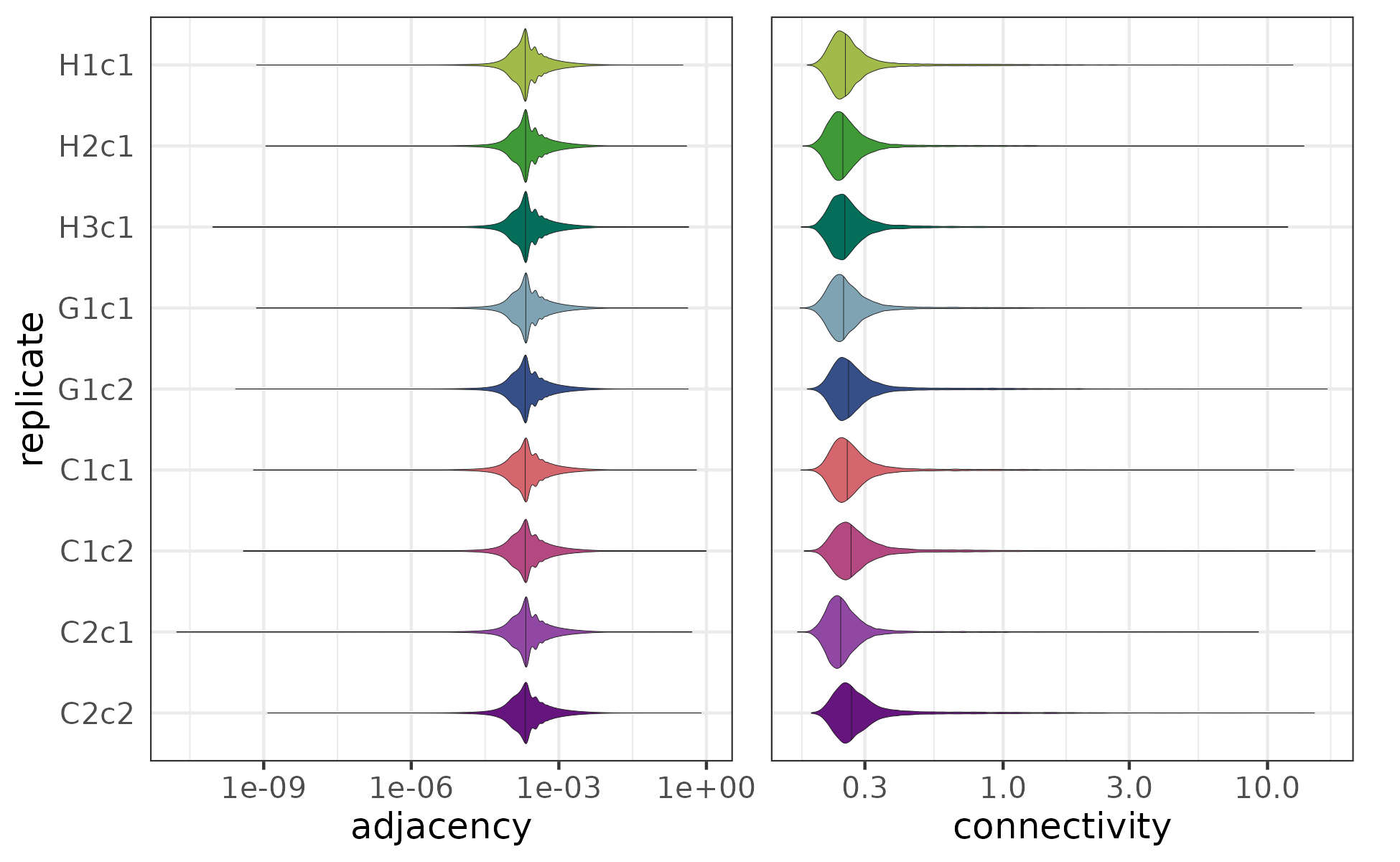
The distribution od adjacencies and connectivities for the networks of the 9 replicates.
Creating the consensus network
As the next step of the workflow, the networks across different replicates and different species are integrated into a single consensus network in a phylogeny-aware manner.
For each edge, the consensus adjacency is calculated as the weighted mean of replicate-wise adjacencies. The weighted mean corrects for 1) the phylogenetic distances between species, and 2) the different numbers of replicates per species. As a result, the approach downweighs the edge weights of the replicates that 1) belong to closely related species, or 2) belong to species with many replicates, so that an imbalanced sampling across the phylogenetic tree does not bias the consensus network.
If a phylogeny-aware consensus is desired, the phylogenetic tree has to be provided. In case of the example dataset, this is the mammalian tree from Bininda-Emonds et al. [13] subsetted for Homo sapiens (human), Gorilla gorilla (gorilla) and Macaca Fascicularis (cynomolgus):
download.file("https://static-content.springer.com/esm/art%3A10.1038%2Fnature05634/MediaObjects/41586_2007_BFnature05634_MOESM362_ESM.txt", here(wd, "mammalian_tree.txt"))
tree <- read.tree(here(wd, "mammalian_tree.txt"))[["treemammalST_bestDates="]] %>%
  keep.tip(c("Homo_sapiens","Gorilla_gorilla", "Macaca_fascicularis"))
tree$tip.label <- c("cynomolgus", "gorilla", "human")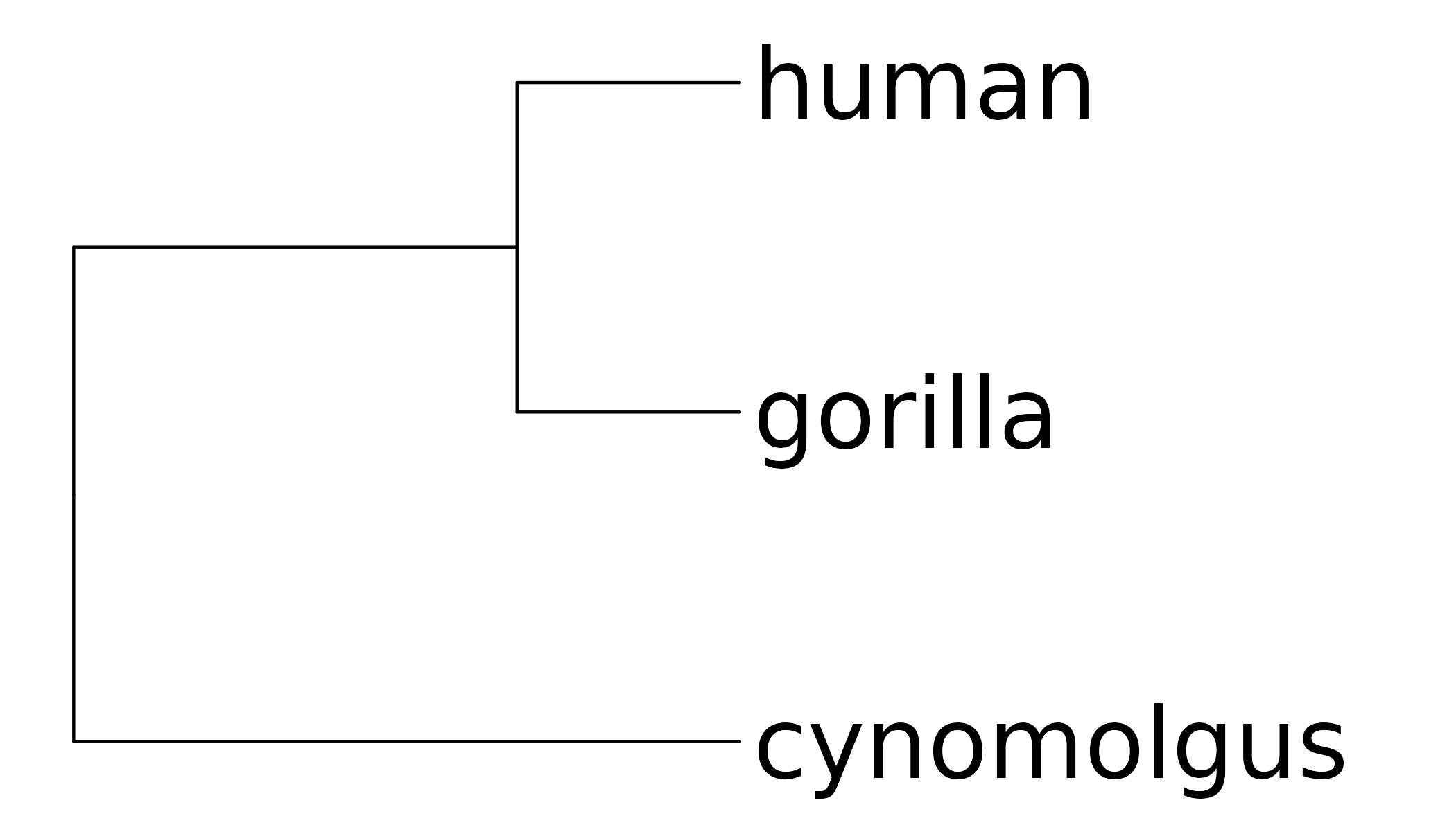
Phylogenetic tree of the species.
Based on the phylogenetic tree and the species assignment of each replicate, the consensus network is computed using the function createConsensus:
consensus_network <- createConsensus(network_list,
                                     replicate2species = replicate2species,
tree = tree)| from | to | weight | n_supporting_replicates | supporting_replicates |
|---|---|---|---|---|
| A1BG | ACAT2 | 0.0000426 | 3 | H3c1,C2c1,C2c2 |
| A1BG | ACBD4 | 0.0000145 | 1 | C2c2 |
| A1BG | ACBD6 | 0.0011186 | 1 | C1c1 |
| A1BG | ACBD7 | 0.0000081 | 1 | C1c1 |
| A1BG | ACER3 | 0.0000665 | 2 | H1c1,H3c1 |
| A1BG | ACIN1 | 0.0001691 | 2 | G1c2,C1c1 |
| A1BG | ACLY | 0.0000402 | 2 | H3c1,C2c1 |
| A1BG | ACO1 | 0.0000244 | 1 | C2c1 |
Adding the direction of correlation
If the network inference method outputs both positive and negative edge weights (e.g. correlation-based methods), the directionality of each edge is saved during the step “Normalizing edge weights”. However, if the networks are inferred using a method that does not distinguish between positively and negatively correlated gene pairs, the directionality can be added in this extra step. The information on directionality is useful because for certain analyses results are more meaning if positively and negatively correlated genes are separated (e.g. eigengene calculation).
The directionality of each edge is determined by calculating a modified Spearman’s correlation between the expression profiles of the two genes forming the edge and assigning the sign of the modified Spearman’s rho as the direction. The calculation uses the approximate Spearman’s rho, significance testing, and blocking implemented in correlatePairs [3].
In case of the example dataset, the networks were inferred using GRNBoost2 which does not provide information about the direction of regulation, therefore it is necessary to perform this step. To get the expression profiles of the network genes, the SCE object needs to be loaded:
sce <- readRDS("processed_data/sce.rds")Next, edge directionality is calculated with the function addDirectionality:
consensus_network <- addDirectionality(consensus_network, sce)| from | to | weight | n_supporting_replicates | supporting_replicates | rho | p.adj | direction |
|---|---|---|---|---|---|---|---|
| A1BG | ACAT2 | 0.0000426 | 3 | H3c1,C2c1,C2c2 | 0.0293 | 0.20 | + |
| A1BG | ACBD4 | 0.0000145 | 1 | C2c2 | -0.0202 | 0.46 | - |
| A1BG | ACBD6 | 0.0011186 | 1 | C1c1 | 0.0063 | 0.83 | + |
| A1BG | ACBD7 | 0.0000081 | 1 | C1c1 | -0.0109 | 0.75 | - |
| A1BG | ACER3 | 0.0000665 | 2 | H1c1,H3c1 | 0.0170 | 0.54 | + |
| A1BG | ACIN1 | 0.0001691 | 2 | G1c2,C1c1 | 0.0234 | 0.35 | + |
| A1BG | ACLY | 0.0000402 | 2 | H3c1,C2c1 | 0.0442 | 0.04 | + |
| A1BG | ACO1 | 0.0000244 | 1 | C2c1 | 0.0221 | 0.43 | + |
Module assignment
Once the consensus network is calculated, it can be used to assign co-expression modules jointly for all species. The center of each module is a transcriptional regulator and the modules are assigned in 2 main steps: 1) large initial modules are created by selecting a fixed number of target genes per regulator, and 2) the initial modules are pruned using a dynamic filtering approach to keep only the best targets of each regulator.
Selecting key transcriptional regulators
First, the transcriptional regulators have to be selected that form the cores of the co-expression modules. To identify regulators that are relevant for the biological process under study, it is a useful approach to combine prior biological knowledge with information derived from the dataset. This step is implemented by the function getRegulators.
As for the prior biological knowledge, we recommend to select only transcriptional regulators with known binding motifs based on motif databases. To get this information, the user can choose the following databases: JASPAR 2024 vertebrate core [14], JASPAR 2024 unvalidated [14], the IMAGE database [15], or any combination of the above. Alternatively, the user can provide a custom list of regulators selected by their preferred method.
As for the information from the dataset, we recommend to select only transcriptional regulators that are among the highly variable genes in the data. For defining highly variable genes, getRegulators relies on scran::getTopHVGs [3]. Briefly, for each species a trend is fitted between the variance and mean of the log-expression values across all genes, and the fitted value of a gene is regarded as the technical component of variation, while the residual from the trend is regarded as the biological component of variation. All genes with a positive biological component are selected as highly variable genes in each species (alternatively, a more stringent variance cutoff, an adjusted p-value cutoff, a fixed number of genes, or a fixed percentage of genes can also be defined). As the final set of highly variable genes, the union of highly variable genes is taken across species.
In case of the example dataset, we used transcriptional regulators that 1) had an annotated motif in any of the 3 motif databases (JASPAR 2024 vertebrate core, JASPAR 2024 unvalidated and IMAGE) and 2) had a positive biological component of variance in any of the species:
regulators <- getRegulators(sce,
                            source = c("jaspar_core", "jaspar_unvalidated", "image"))
This gave us 836 transcriptional regulators that included well-known pluripotency factors and early neural regulators:
length(regulators)
#> [1] 836Assigning initial modules
Once the regulators that provide the starting point of the module assignment are selected, an initial module can be defined around each of them using the function assignInitialModules. Each of these modules contain the regulator and its N best target genes (N is recommended to be between 1000 and 5000). When choosing the best targets, the genes are ranked based on how strongly they are connected to the regulator (regulator-target adjacency).
In case of the example dataset, we defined 4000 as the number of genes in the initial modules:
initial_modules <- assignInitialModules(consensus_network,
                                        regulators = regulators,
N = 4000)| regulator | target | weight | n_supporting_replicates | supporting_replicates | rho | p.adj | direction |
|---|---|---|---|---|---|---|---|
| POU5F1 | ACAT2 | 0.00080 | 4 | H1c1,G1c1,C2c1,C2c2 | 0.125 | 1e-12 | + |
| POU5F1 | ACCS | 0.00016 | 4 | G1c1,G1c2,C1c2,C2c1 | 0.092 | 5e-06 | + |
| POU5F1 | ACER3 | 0.00053 | 3 | H1c1,G1c1,C1c2 | 0.090 | 1e-06 | + |
| POU5F1 | ACLY | 0.00081 | 4 | H1c1,G1c1,C2c1,C2c2 | 0.189 | 2e-27 | + |
| POU5F1 | ACOT13 | 0.00300 | 6 | H1c1,H3c1,G1c1,G1c2, C1c2,C2c2 | 0.086 | 7e-08 | + |
| POU5F1 | ACOT7 | 0.00475 | 8 | H1c1,H2c1,G1c1,G1c2, C1c1,C1c2,C2c1,C2c2 | 0.337 | 7e-96 | + |
| POU5F1 | ACOT8 | 0.00083 | 3 | G1c1,C1c1,C2c2 | 0.212 | 3e-35 | + |
| POU5F1 | ACP1 | 0.00053 | 3 | G1c2,C1c2,C2c1 | 0.113 | 9e-11 | + |
The resulting modules are obviously too large at this point to be biologically meaningful. The purpose of this step is rather to select a uniformly sized pool of genes for all modules to perform the pruning step on.
Module pruning
The goal of pruning is to keep only the best targets of each transcriptional regulator and thereby create biologically meaningful modules that consist of co-regulated genes with shared cellular functions.
Which targets are the best can be defined based on 2 metrics:
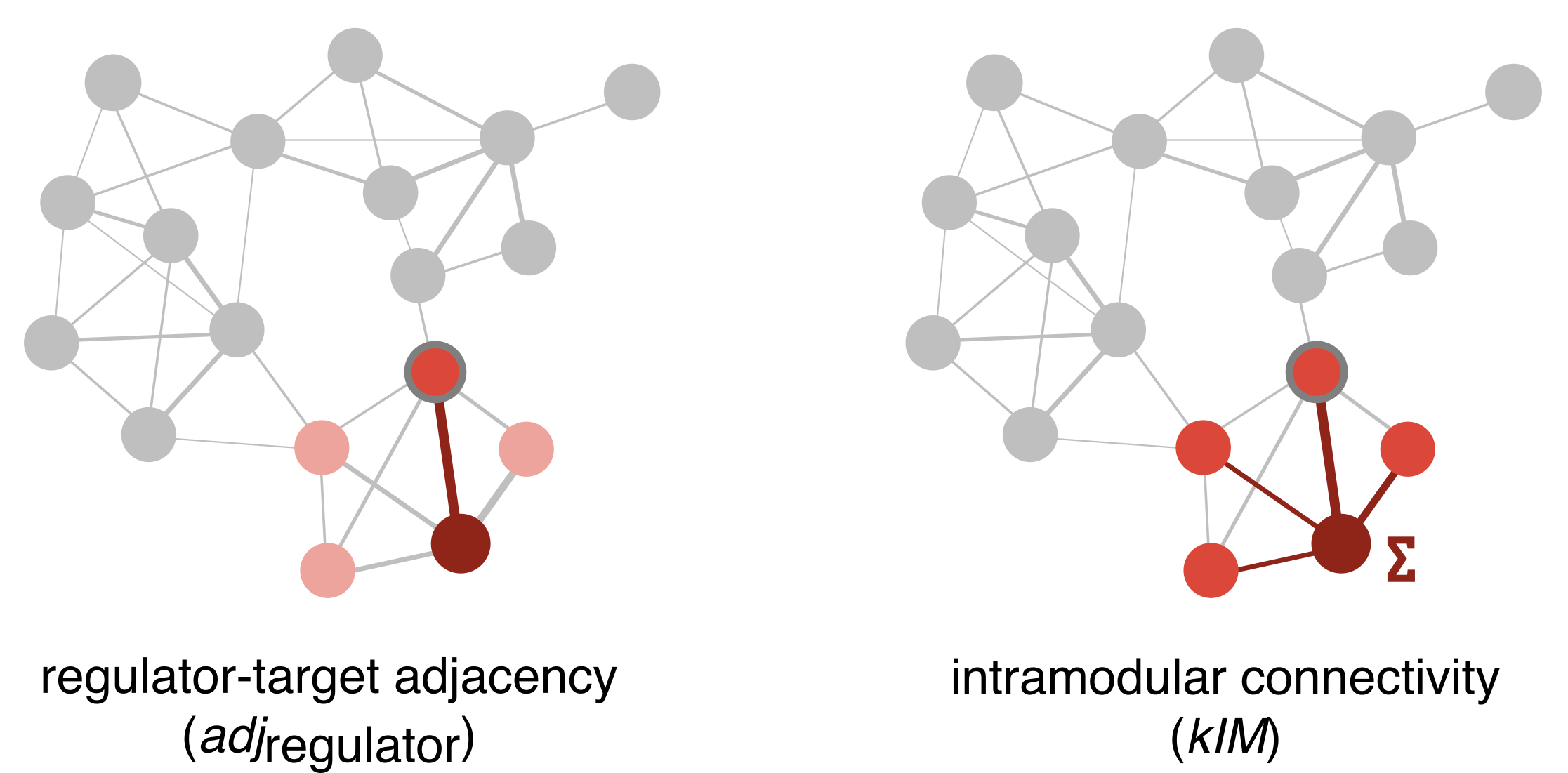
Network concepts used for module pruning: regulator-target adjacency and intramodular connectivity.
-
Regulator-target adjacency (): The adjacency between a transcriptional regulator and a member gene in its module. It ranges between 0 and 1 with a higher value representing a stronger (activating or repressing) regulatory relationship.
Pro: Pruning based on the regulator-target adjacencies selects the genes whose expression profiles co-vary the most with the regulator’s expression profile.
Con: Modules created based on the regulator-target adjacencies alone might not fulfill the expectation of being densely connected blocks of genes, apart from the link to the regulator, the target genes often only have sparse/weak connections within the module (danger of false positives).
-
Intramodular connectivity (kIM): The sum of adjacencies between a specific gene and all other members of the module. If the module size is n, it ranges between 0 and n - 1 with a higher value representing a gene that is more strongly connected to the rest of the module.
Pro: Pruning based on intramodular connectivities in addition to the regulator-target adjacencies ensures that the chosen targets co-vary not just with the main regulator but also with the rest of the module. These intramodular connections between targets can carry important information that are not captured by the links between regulator and targets alone (e.g. combinatorial regulation).
Con: Genes that have a generally high connectivity but do not have a particularly strong regulatory relationship with the transcriptional regulator might end up in the final module.
The initial targets can be filtered based one or both of these metrics using 2 approaches:
-
topN: Keeps a fixed number of targets (default: 50) per regulator.
Pro: Quick, simple and widespread.
Con: The approach assigns the same number of target genes to each regulator even though biologically speaking different regulators can have an effect on different numbers of genes. The number of targets is in most cases arbitrary and does not take into account the structure of the data at hand.
-
UIK: Applies dynamic stepwise pruning using knee-point detection. In each step, the cumulative sum curve based on the metric of choice is calculated per module, the knee point of the curve is identified using the Unit Invariant Knee (UIK) method, then only the targets that rank higher than the knee point are kept. The modules containing less target genes than a minimum module size (default: 20) are removed after each pruning step. The steps continue until the percentage of removed modules becomes too high (default: >2%).
Pro: While setting a minimum module size prevents the modules from becoming too small, the exact number of target genes per regulator does not have to be pre-defined, in line with the notion that different regulators can have an effect on different numbers of genes. There are also no hard cutoffs applied to the regulator-target adjacencies or intramodular connectivities, but by using knee point detection the target genes are filtered in a data-driven way.
Con: The approach still requires a predefined minimum module size.
Compared to clustering-based module assignment approaches, both pruning methods have the advantage that the modules are allowed to overlap, and in addition to having its own module, a regulator can be assigned to another regulator’s module as well. This is in line with the notion that genes can fulfill several different functions in the cell and gene regulation can be combinatorial.
In case of both pruning methods, when setting the fixed module size or the threshold for the minimum module size not just biological but also technical aspects have to be taken into consideration: for modules smaller than ~20 genes, the correlation-based preservation statistics in the next steps might be coupled with high uncertainty, therefore they should be avoided.
Using the metrics and approaches described above, we implemented 3 methods for module pruning:
topN: Takes a fixed number of targets per regulator with the highest regulator-target adjacencies.
UIK_adj: Applies a dynamic stepwise pruning based on the regulator-target adjacencies.
UIK_adj_kIM: Applies a dynamic stepwise pruning based on the regulator-target adjacencies and intramodular connectivities alternately.
In case of the example dataset, we used the method “UIK_adj_kIM”:
pruned_modules <- pruneModules(initial_modules,
                               method = "UIK_adj_kIM",
                               consensus_network = consensus_network)
The following figure shows the steps of the pruning process for the POU5F1 module:
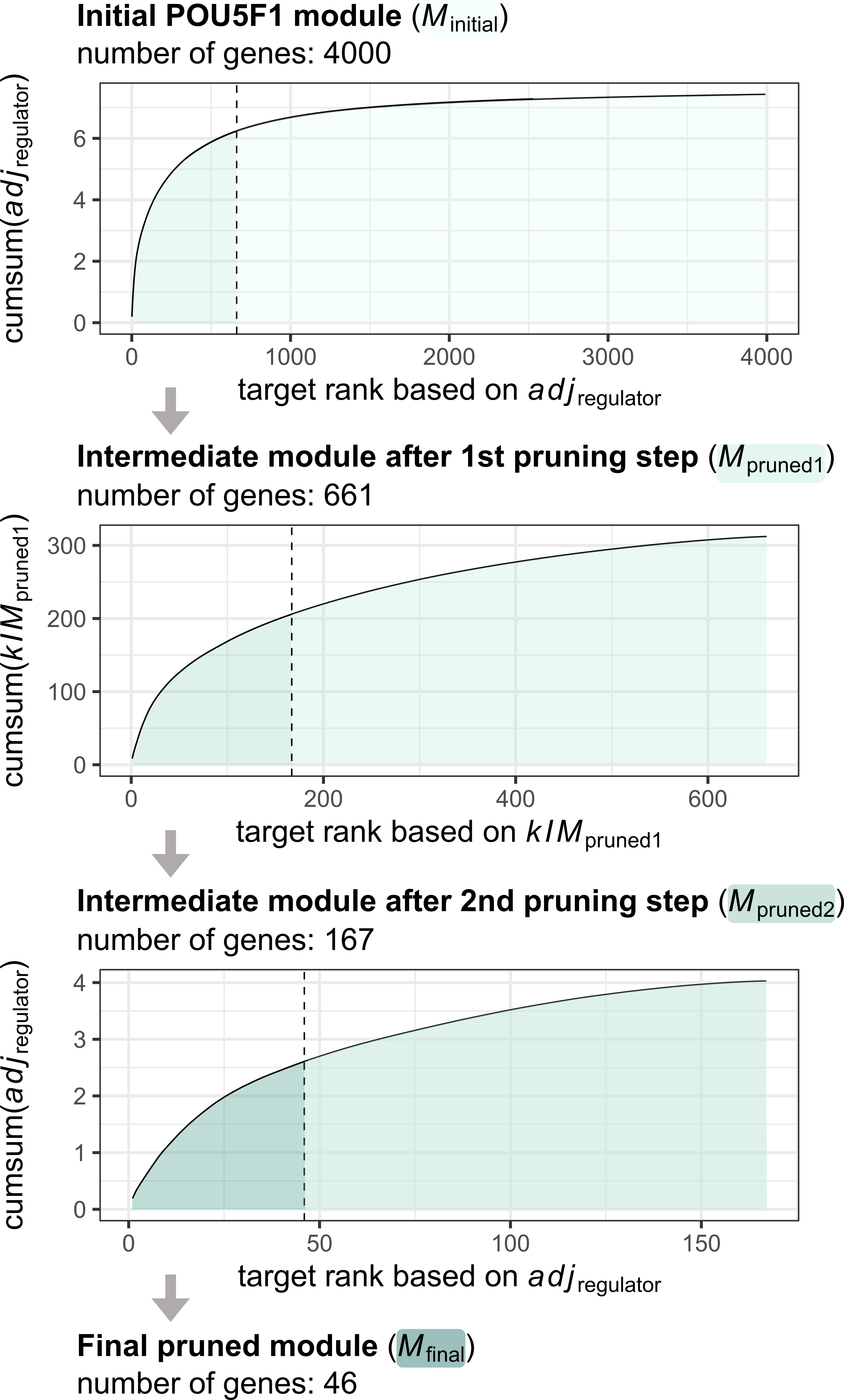
Stepwise dynamic pruning approach exemplified by the POU5F1 module. In each step, we calculated the cumulative sum curve of the regulator-target adjacency or intramodular connectivitiy of the target genes alternately, then kept the targets that fell below the knee point of the curve. We continued this process for 3 iterations - until the module sizes became as small as possible without falling below 20 genes.
| regulator | target | weight | kIM | n_supporting_ replicates | supporting_ replicates | rho | p.adj | direction | module_size |
|---|---|---|---|---|---|---|---|---|---|
| POU5F1 | AP1S2 | 0.026 | 0.4140710 | 8 | H1c1,H2c1,H3c1, G1c2,C1c1,C1c2, C2c1,C2c2 | 0.38 | 3e-127 | + | 46 |
| POU5F1 | APOE | 0.075 | 1.1619107 | 9 | H1c1,H2c1,H3c1, G1c1,G1c2,C1c1, C1c2,C2c1,C2c2 | 0.58 | 0 | + | 46 |
| POU5F1 | CD24 | 0.143 | 1.9220911 | 9 | H1c1,H2c1,H3c1, G1c1,G1c2,C1c1, C1c2,C2c1,C2c2 | 0.63 | 0 | + | 46 |
| POU5F1 | CDH2 | 0.036 | 0.6176581 | 8 | H1c1,H2c1,H3c1, G1c1,G1c2,C1c1, C1c2,C2c2 | -0.46 | 1e-194 | - | 46 |
| POU5F1 | CENPV | 0.025 | 0.4156734 | 8 | H1c1,H3c1,G1c1, G1c2,C1c1,C1c2, C2c1,C2c2 | -0.33 | 6e-93 | - | 46 |
| POU5F1 | CHCHD2 | 0.031 | 0.5833867 | 7 | H2c1,H3c1,G1c2, C1c1,C1c2,C2c1, C2c2 | 0.39 | 8e-135 | + | 46 |
| POU5F1 | CLDN6 | 0.033 | 0.5877413 | 9 | H1c1,H2c1,H3c1, G1c1,G1c2,C1c1, C1c2,C2c1,C2c2 | 0.57 | 0 | + | 46 |
| POU5F1 | COX7C | 0.097 | 1.9427046 | 9 | H1c1,H2c1,H3c1, G1c1,G1c2,C1c1, C1c2,C2c1,C2c2 | 0.58 | 0 | + | 46 |
Since we use the “UIK_adj_kIM” approach, the final module sizes are not predefined but shaped by the data. For this particular dataset, the number of genes in the pruned modules range from 25 to 63 with a median of 45:
plotModuleSizeDistribution(pruned_modules)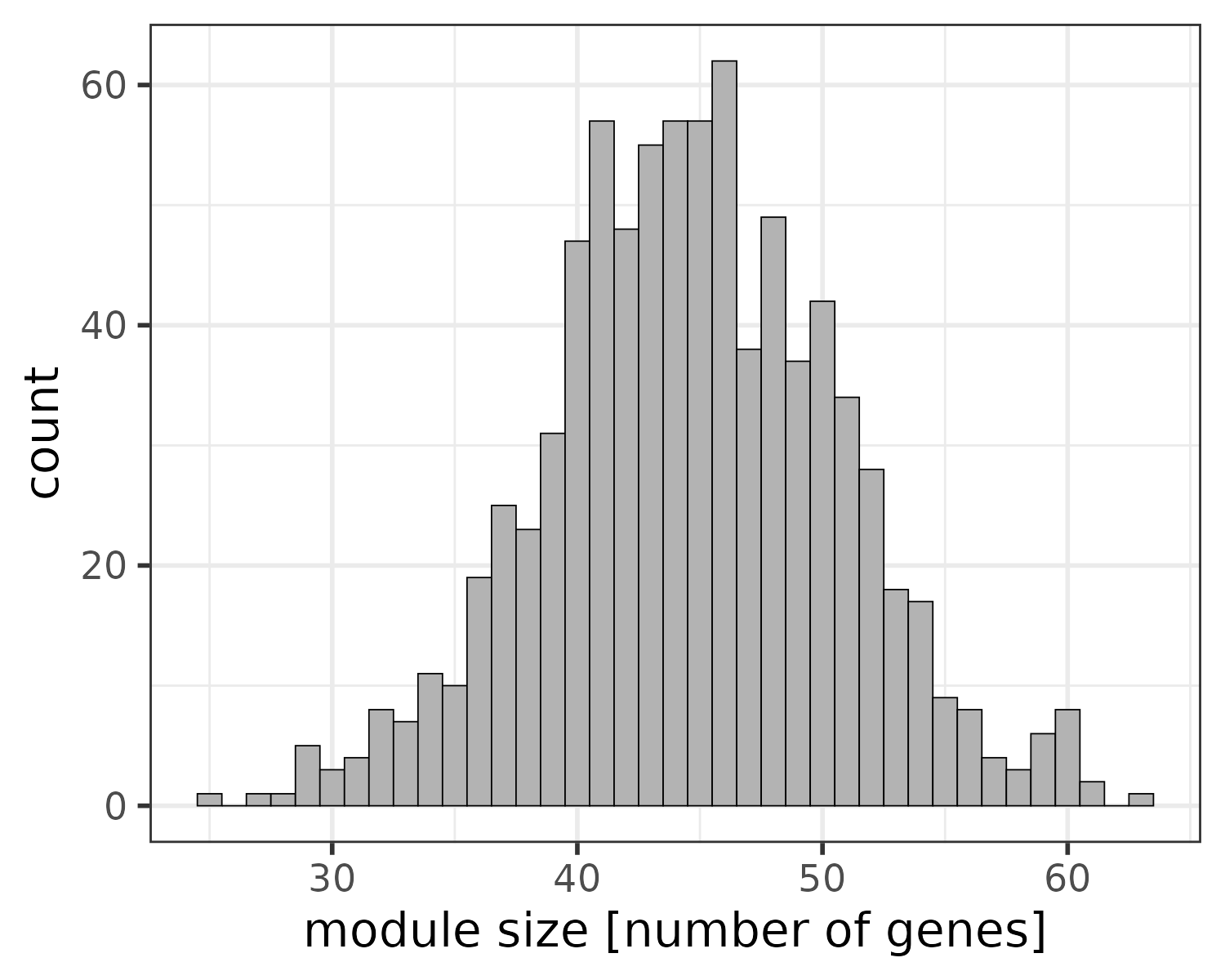
Distribution of module sizes after pruning. Median size: 45.
Visualizing modules
The most important connections of the modules can be plotted using the function plotNetworks. For each module, the resulting plots show the strongest intramodular connections based on the consensus network and the genes involved in these connections. The following plot depicts the top 300 connections of 6 example modules, colored by the direction of correlation:
example_modules <- c("NANOG", "POU5F1", "SALL4",  "NEUROD4", "PAX6", "FEZF2")
plotNetworks(example_modules,
             pruned_modules,
             consensus_network,
             color_by = "direction")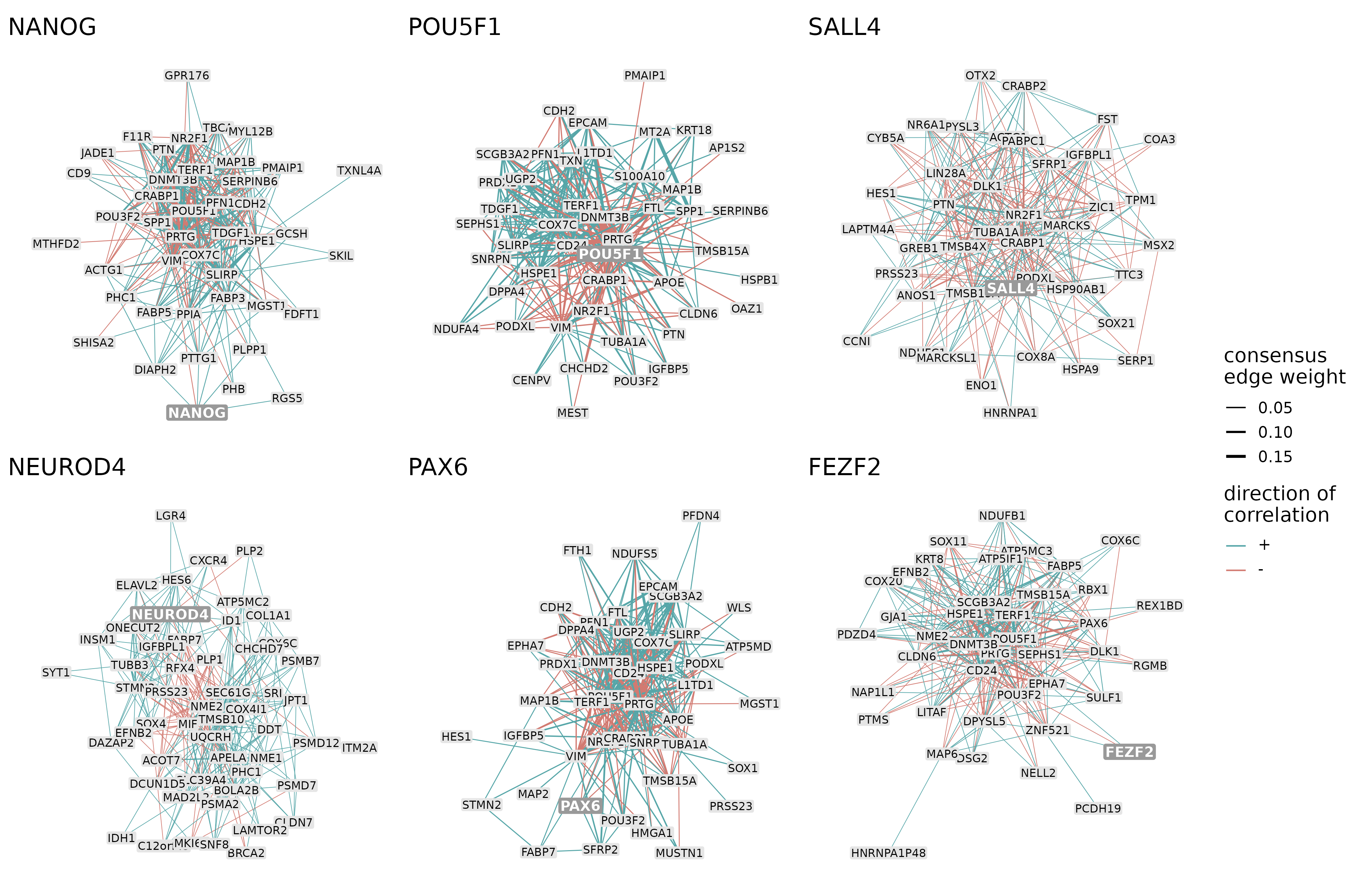
The 300 strongest connections of 6 example modules. The thickness of the edges represents the consensus edge weights and the color of the edges represents the direction of interaction (positively/negatively correlated).
Creating random modules
Along with the pruned modules, there is an option to create random modules as well using the function createRandomModules. The random modules have the same regulators and contain the same number of target genes as the actual pruned modules, but these target genes are randomly drawn from all network genes.
genes <- rownames(sce)
random_modules <- createRandomModules(pruned_modules,
                                      network_genes = genes)
In the next steps of the pipeline, the actual modules are compared to these random modules in terms of various statistics to check whether the two groups of modules behave in general differently and to remove those individual actual modules that show too similar characteristics to the random modules.
Characterizing modules
Since co-expression modules are often more closely associated with a cellular function than any particular gene alone, it is informative to investigate which cell types the different modules are active in and which pathways they are associated to. This can be achieved for example by calculating module eigengenes and peforming gene set enrichment analysis.
Calculating module eigengenes
A concept adapted from WGCNA [16], a module eigengene summarizes the expression profile of an entire module, and it is calculated as the first principal component of the module expression data. Effectively, it is a weighted mean of the individual genes’ expression profiles. In CroConet, the calculation of eigengene profiles is implemented by calculateEigengenes. This function outputs other metrics as well for representing the expression patterns of a module, namely the mean expression across all module members and the expression of the regulator.
If a module contains both activated and repressed targets of the transcriptional regulator, calculating the eigengene (or any other summary expression profiles) across both directions of regulation does not make biological sense and leads to the dilution of signal. It makes more sense to calculate the eigengene either for the activated targets only (direction_of_regulation = “+_only”, the default) or for the activated and repressed targets separately (direction_of_regulation = “+-_separately”). If an eigengene across all targets is desired irrespective of the direction of regulation, direction_of_regulation should be set to “all_together”.
In case of the example dataset, we calculated module eigengenes for the activated targets of each module:
eigengenes <- calculateEigengenes(regulators,
                                  pruned_modules,
                                  sce,
direction_of_regulation = "+_only")| cell | species | pseudotime | cell_type | module | eigengene | mean_expr | regulator_expr |
|---|---|---|---|---|---|---|---|
| ATCTCAGGAAAACT | human | 0.504 | Early_Ectoderm | POU5F1(+) | -0.008 | -0.317 | 0.242 |
| ATCTCAGGAAAGTT | human | 0.604 | Early_Ectoderm | POU5F1(+) | -0.013 | -0.529 | -0.760 |
| ATCTCAGGAAATTG | human | 0.570 | Early_Ectoderm | POU5F1(+) | -0.011 | -0.422 | -0.015 |
| ATCTCAGGAAGATT | human | 0.568 | Early_Ectoderm | POU5F1(+) | -0.009 | -0.347 | -0.760 |
| ATCTCAGGAATACA | human | 0.525 | Early_Ectoderm | POU5F1(+) | -0.008 | -0.275 | -0.760 |
| ATCTCAGGAATCTT | human | 0.515 | Early_Ectoderm | POU5F1(+) | -0.008 | -0.286 | -0.760 |
| ATCTCAGGACAATA | human | 0.576 | Early_Ectoderm | POU5F1(+) | -0.010 | -0.405 | -0.760 |
| ATCTCAGGACCGGC | human | 0.525 | Early_Ectoderm | POU5F1(+) | -0.005 | -0.190 | -0.760 |
The eigengene profiles can then be plotted as a heatmap using plotEigengeneHeatmap. Here we focus on the 6 example modules again, that contain 3 pluripotency regulators (NANOG, POU5F1 and SALL4) and 3 neural regulators (NEUROD4, PAX6 and FEZF2):
eigengenes_examples <- eigengenes %>%
  dplyr::filter(module %in% paste0(example_modules, "(+)")) %>%
  dplyr::mutate(module = factor(module, paste0(example_modules, "(+)")))
plotEigengeneHeatmap(eigengenes_examples)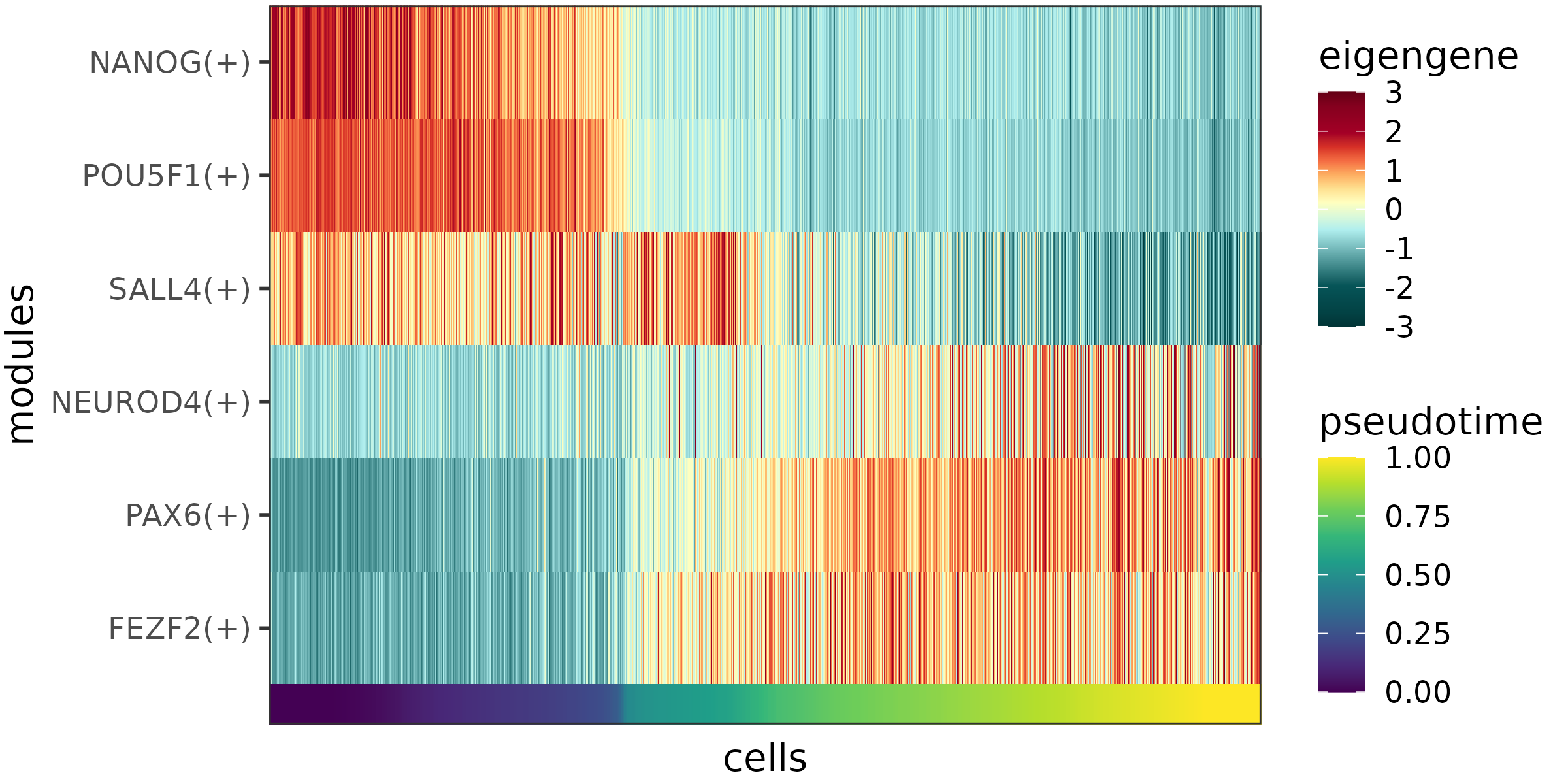
The eigengenes of the example modules.
As expected, the activated targets of the pluripotency regulators show the highest expression levels at early pseudotime stages and become downregulated later on, while the activated targets of the neural regulators have low expression levels at first, and become upregulated towards later stages of the differentiation process.
Gene set enrichment analysis
Gene set enrichment analysis offers useful information for the functional annotation of the modules. Various databases and tools can be used for such an analysis, including Gene Ontology (GO) [17, 18] and the related R package topGO [19], the Reactome Pathway Database [20] and the R package ReactomePA [21], or STRING [22] and the R package STRINGdb [22]. It is also worth mentioning clusterProfiler [23] which provides a universal interface for enrichment analysis based on various sources and makes it easy to analyze and compare several different gene sets in a single run.
In the next steps, we perform pathway enrichment analysis on the 6 example modules using the Reactome Pathway Database. First, a data frame containing the activated targets of the example modules is prepared and the gene names are converted to ENTREZ IDs using the conversion table stored in “sym2enrtez.rds” (this was created based on the GENCODE “Entrez gene ids” metadata file corresponding to the human genome version used for mapping).
sym2entrez <- readRDS("RDS/sym2entrez.rds")
example_modules_4_reactome <- pruned_modules %>%
  dplyr::filter(regulator %in% example_modules & direction == "+") %>%
  dplyr::bind_rows(data.frame(regulator = example_modules,
                              target = example_modules)) %>%
  dplyr::inner_join(sym2entrez, by = c("target" = "gene_name")) %>%
  dplyr::mutate(regulator = factor(regulator, example_modules))
Next, the enrichment analysis is done using the wrapper function clusterProfiler::compareCluster and the testing implemented by ReactomePA::enrichPathway. The universe is defined as all network genes.
enrich_res <- clusterProfiler::compareCluster(entrez_id ~ regulator,
                                              "enrichPathway",
                                              example_modules_4_reactome,
                                              universe = unique(sym2entrez$entrez_id))
Finally, the results are plotted for all modules together:
clusterProfiler::dotplot(enrich_res, showCategory = 3)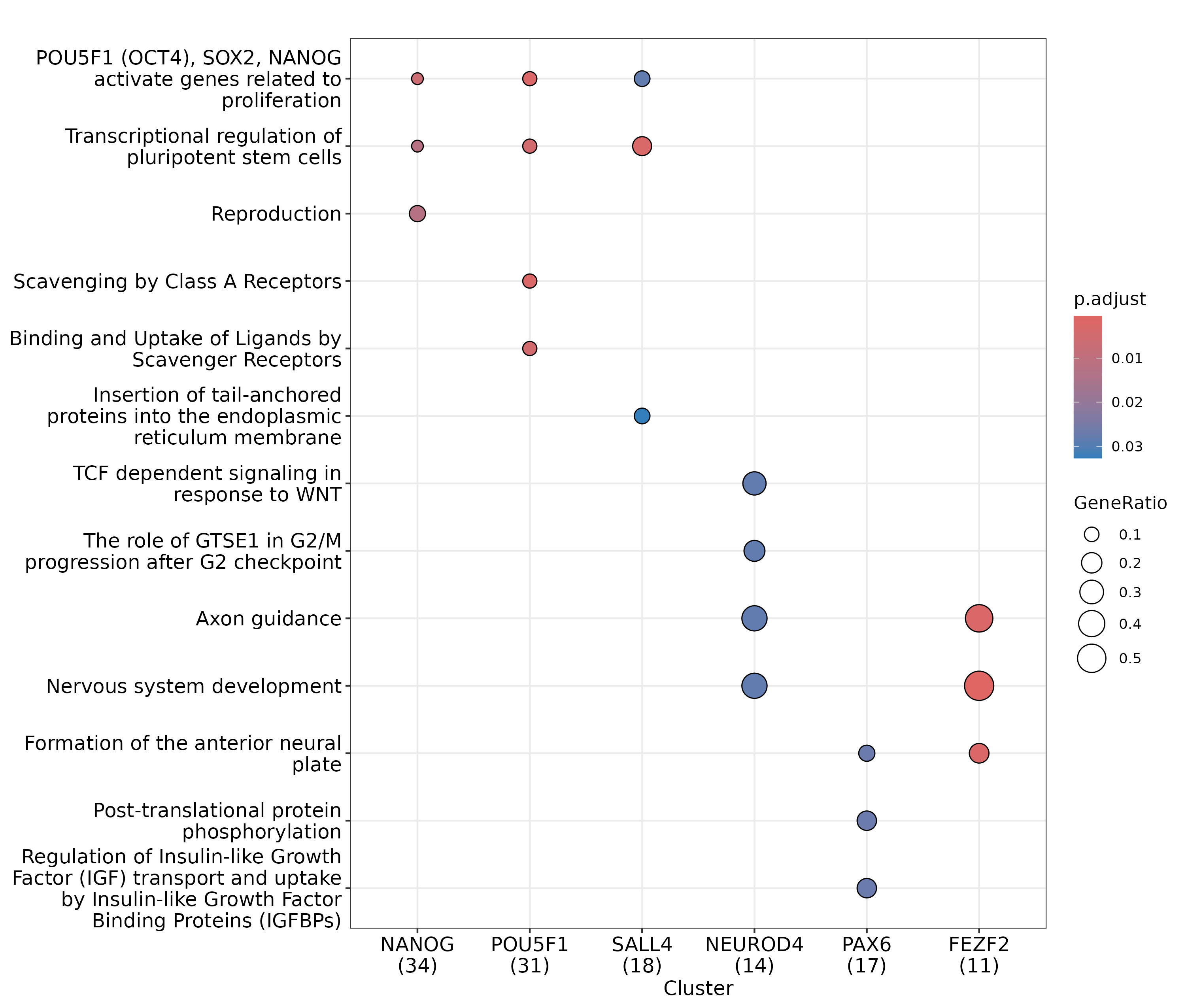
Reactome enrichment analysis on 6 example modules.
Encouragingly, the modules of the pluripotency regulators show enrichment for several pathways related to pluripotency (e.g. POU5F1 (OCT4), SOX2, NANOG activate genes related to proliferation and Transcriptional regulation of pluripotent stem cells), while the modules of the neural regulators show enrichment for several pathways related to the nerual lineage (e.g. Axon guidance and Nervous system development).
Module preservation within and across species
In the next part of the CroCoNet workflow, we quantify how well-preseved the topologies of the modules are between different pairs of replicates, both within and across species, and summarize these preservation scores as neighbour-joining trees per module.
Calculating module preservation statistics
For the calculation of preservation statistics, we use the joint module assignment derived from the consensus network but compare topological properties directly between the replicate-wise networks. This way, a module is always defined as the same set of genes, but the adjacencies and connectivities of these genes can differ from replicate to replicate; poorly preserved modules are expected to have many, while well-preserved modules are expected to have few such topological differences.
Compared to the standard approach of cross-species module comparison (defining modules for each species separately and then cross-tabulating the module member genes across species), topology-based metrics can detect way more subtle differences. In addition, the results of cross-tabulation are strongly affected by statistical power: if we find a low overlap across species, it is difficult to disentangle to what extent this is due to real biological differences and to what extent this is just due to having a low power for module detection in the first place. In contrast, a comparison of network topology for a joint module assignment is much less dependent on the power.
As part of the function calculatePresStats, two preservation statistics (adapted from WGCNA [24]) are implemented to quantify different aspects of this topological comparison:
Correlation of adjacencies (cor_adj): the correlation of all edge weights within the module in the network of replicate1 VS in the network of replicate2 where is the vector of intramodular adjacencies in module and network .
Correlation of intramodular connectivities (cor_kIM): the correlation of the intramodular connectivities per module member gene in the network of replicate1 VS in the network of replicate2 where is the vector of intramodular connetivities per gene in module and network .
Both of these statistics can be calculated with module jackknifing (by setting jackknife to TRUE). This means that the function creates all possible jackknifed versions of each input module by removing each target gene assigned to that module (the regulator itself is never excluded), then it calculates the preservation statistics for all of these jackknifed module versions in addition to the original module. The advantage of using jackknfing is that a confidence interval can be calculated for each module and statistic instead of just getting a single value. Later on in the pipeline, jackknifing can also provide information about which target genes within a conserved/diverged module are particularly responsible for the conservation/divergence. If jackknifing is not desired, the user can just set jackknife to FALSE which will also substantially reduce running times.
In case of the example dataset, we calculated both preservation statistics and opted for using jackknifing:
pres_stats_jk <- calculatePresStats(pruned_modules,
                                    network_list,
                                    c("cor_adj", "cor_kIM"),
                                    replicate2species,
                                    jackknifing = TRUE)
random_pres_stats_jk <- calculatePresStats(random_modules,
                                           network_list,
                                           c("cor_adj", "cor_kIM"),
                                           replicate2species,
jackknifing = TRUE)| regulator | type | id | gene_ removed | replicate1 | replicate2 | species1 | species2 | cor_adj | cor_kIM |
|---|---|---|---|---|---|---|---|---|---|
| POU5F1 | orig | POU5F1_orig | NA | H1c1 | H2c1 | human | human | 0.589 | 0.726 |
| POU5F1 | orig | POU5F1_orig | NA | H1c1 | H3c1 | human | human | 0.543 | 0.696 |
| POU5F1 | orig | POU5F1_orig | NA | H1c1 | G1c1 | human | gorilla | 0.474 | 0.644 |
| POU5F1 | orig | POU5F1_orig | NA | H1c1 | G1c2 | human | gorilla | 0.544 | 0.676 |
| POU5F1 | jk | POU5F1_jk_APOE | APOE | H1c1 | H2c1 | human | human | 0.585 | 0.724 |
| POU5F1 | jk | POU5F1_jk_APOE | APOE | H1c1 | H3c1 | human | human | 0.537 | 0.688 |
| POU5F1 | jk | POU5F1_jk_APOE | APOE | H1c1 | G1c1 | human | gorilla | 0.489 | 0.666 |
| POU5F1 | jk | POU5F1_jk_APOE | APOE | H1c1 | G1c2 | human | gorilla | 0.556 | 0.697 |
If the preservation statistics are calculated with jackknifing, a statistic of interest can be estimated for a module as a whole by taking its median across all jackknifed versions along with the confidence interval if the median. This summarization is performed by the function summarizeJackknifePresStats:
pres_stats <- summarizeJackknifeStats(pres_stats_jk)
random_pres_stats <- summarizeJackknifeStats(random_pres_stats_jk)| regulator | replicate1 | replicate2 | species1 | species2 | cor_adj | var_cor_adj |
|---|---|---|---|---|---|---|
| POU5F1 | H1c1 | H2c1 | human | human | 0.590 | 0.000113 |
| POU5F1 | H1c1 | H3c1 | human | human | 0.544 | 0.000154 |
| POU5F1 | H1c1 | G1c1 | human | gorilla | 0.473 | 0.000251 |
| POU5F1 | H1c1 | G1c2 | human | gorilla | 0.545 | 0.000236 |
| lwr_cor_adj | upr_cor_adj | cor_kIM | var_cor_kIM | lwr_cor_kIM | upr_cor_kIM |
|---|---|---|---|---|---|
| 0.585 | 0.593 | 0.727 | 0.000224 | 0.724 | 0.731 |
| 0.539 | 0.546 | 0.695 | 0.000284 | 0.688 | 0.700 |
| 0.470 | 0.478 | 0.641 | 0.000327 | 0.638 | 0.646 |
| 0.540 | 0.547 | 0.673 | 0.000410 | 0.668 | 0.677 |
There are two expectations that a statistic is expected to fulfill if it is a good measure of module preservation:
The scores are expected to be higher for the actual modules than for the random modules.
The scores are expected to decrease with increasing phylogenetic distance between the replicates compared.
As a visual check, the function plotPresStatDistributions plots the distributions of the preservation scores for the actual and random modules and for within-species and cross-species replicate pairs, whereas the function plotPresStats plots the cross-species scores against the within-species scores per species pair:
plotPresStatDistributions(pres_stats,
                          random_pres_stats,
                          c("cor_adj", "cor_kIM"))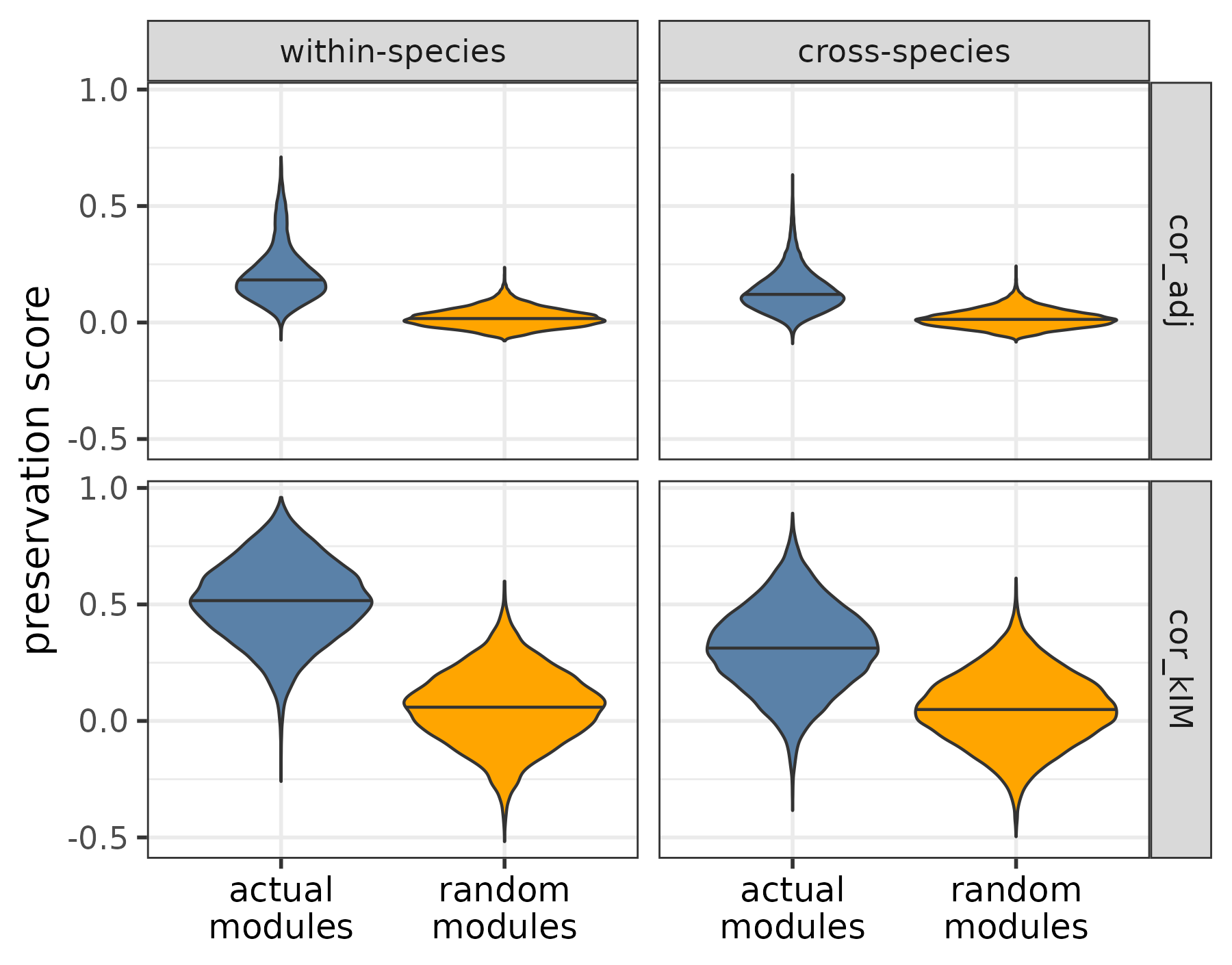
Distribution of preservation statistics within and across species, for the actual and random modules.
plotPresStats(pres_stats,
              random_pres_stats,
              c("cor_adj", "cor_kIM"))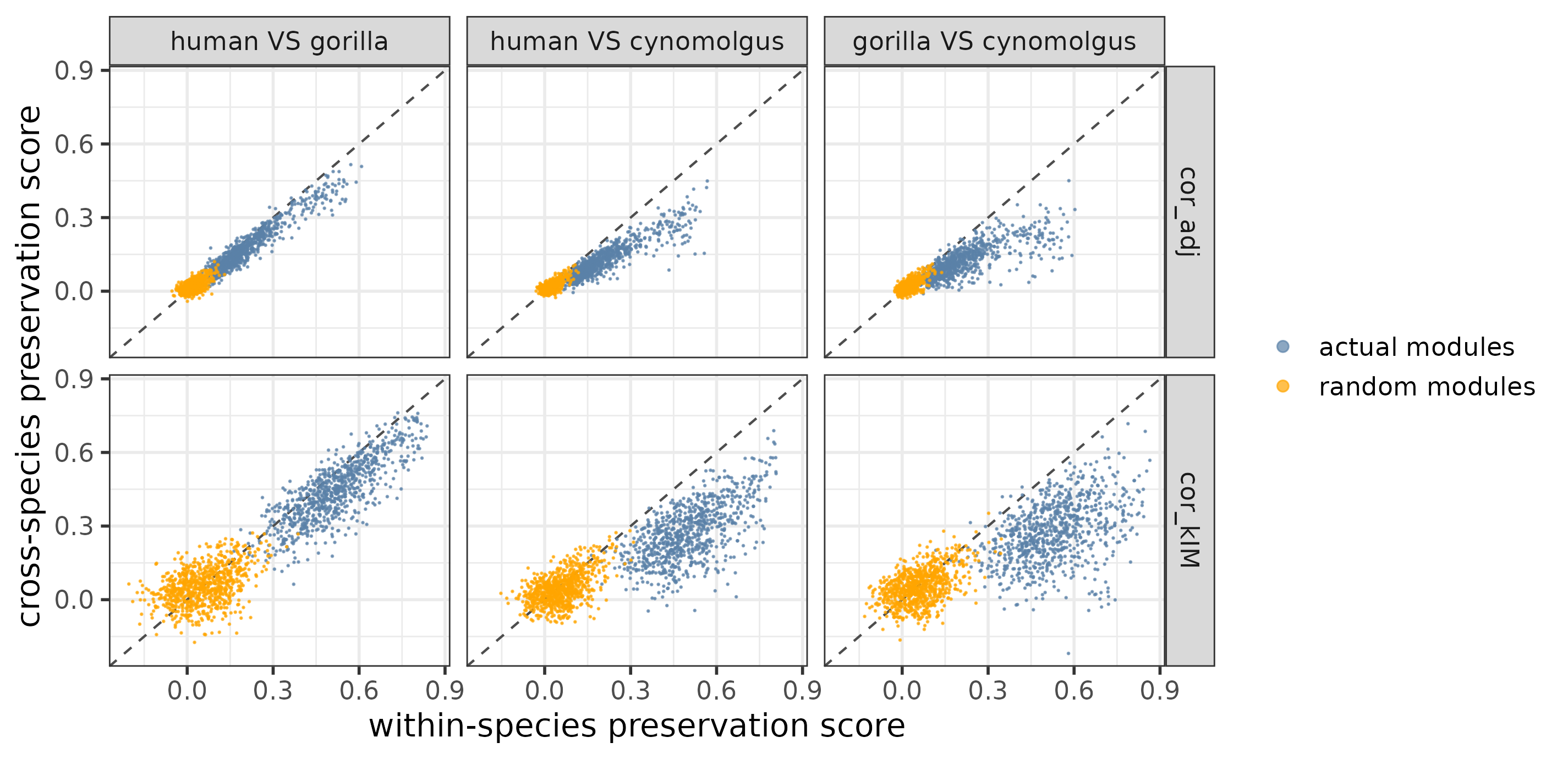
Cross-species VS within-species preservation scores per species pair for the actual and random modules.
The plots show that when applied to the example dataset, both cor.kIM and cor.adj fulfill the expectations. To quantitatively compare which of the two statistics performs better, the function comparePresStats plots 1) the difference in preservation between each actual and the corresponding random module, and 2) the inverse Pearson’s correlation (-r) between the preservation scores and phylogenetic distance:
comparePresStats(pres_stats,
                 random_pres_stats,
                 tree)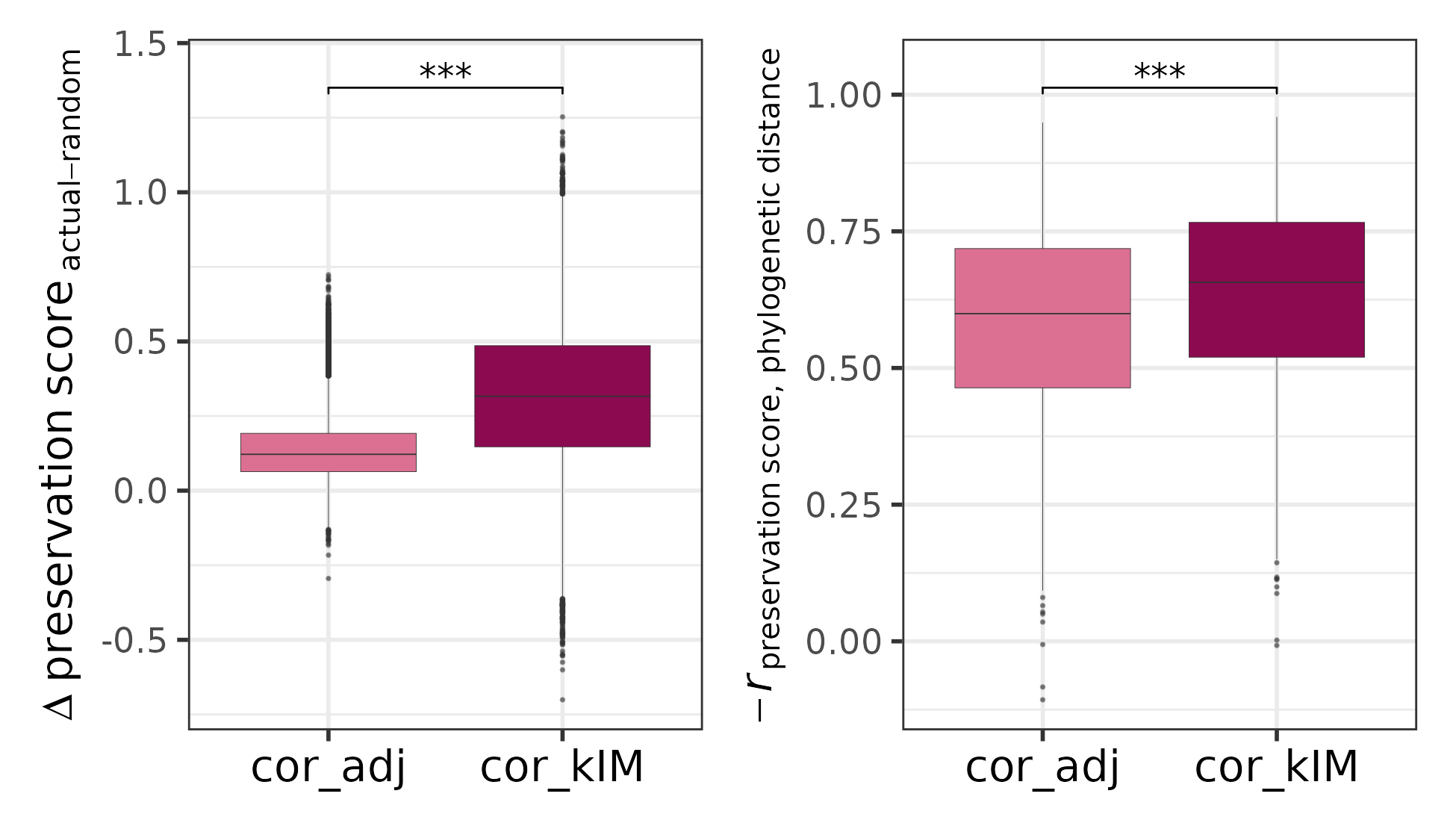
Difference of the cor.kIM / cor.adj scores between each actual and the corresponding random module (left) and inverted Pearson’s correlation (-r ) between cor.kIM / cor.adj and phylogenetic distance (right).
Since the difference between the actual and random modules as well as the strength of the phylogenetic signal are higher for cor.kIM, we use this statistic for the rest of the analysis.
Converting preservation scores to distance measures
As a preparation for tree reconstruction, the preservation statistics need to be converted to distance measures. This is done by the function convertPresToDist using the formula: where is the distance measure and is the preservation statistic. The resulting distances range between 0 and 1: a distance of 0 corresponds to a preservation score of 1, while a distance of 1 corresponds to a preservation score of -1.
dist_jk <- convertPresToDist(pres_stats_jk, "cor_kIM")
random_dist_jk <- convertPresToDist(random_pres_stats_jk, "cor_kIM")
The resulting object is a list, where each list element stores the distance measures of a module (an original or jackknifed module version, if jackknifing is used) in a data frame format:
| regulator | type | id | gene_removed | replicate1 | replicate2 | species1 | species2 | dist |
|---|---|---|---|---|---|---|---|---|
| POU5F1 | jk | POU5F1_jk_APOE | APOE | H1c1 | H2c1 | human | human | 0.138 |
| POU5F1 | jk | POU5F1_jk_APOE | APOE | H1c1 | H3c1 | human | human | 0.156 |
| POU5F1 | jk | POU5F1_jk_APOE | APOE | H1c1 | G1c1 | human | gorilla | 0.167 |
| POU5F1 | jk | POU5F1_jk_APOE | APOE | H1c1 | G1c2 | human | gorilla | 0.151 |
The distance measures of a module can be organized into and plotted as a distance matrix. For visualization, it is usually the simplest and most informative to focus on the original (not jackknifed) modules only:
The function plotDistMats plots the distance matrix of a single module (required input: data frame) or the distance matrices of several modules together (required input: list of data frames), for example it can be used to visualize the six example modules side by side:
plotDistMats(dist[example_modules])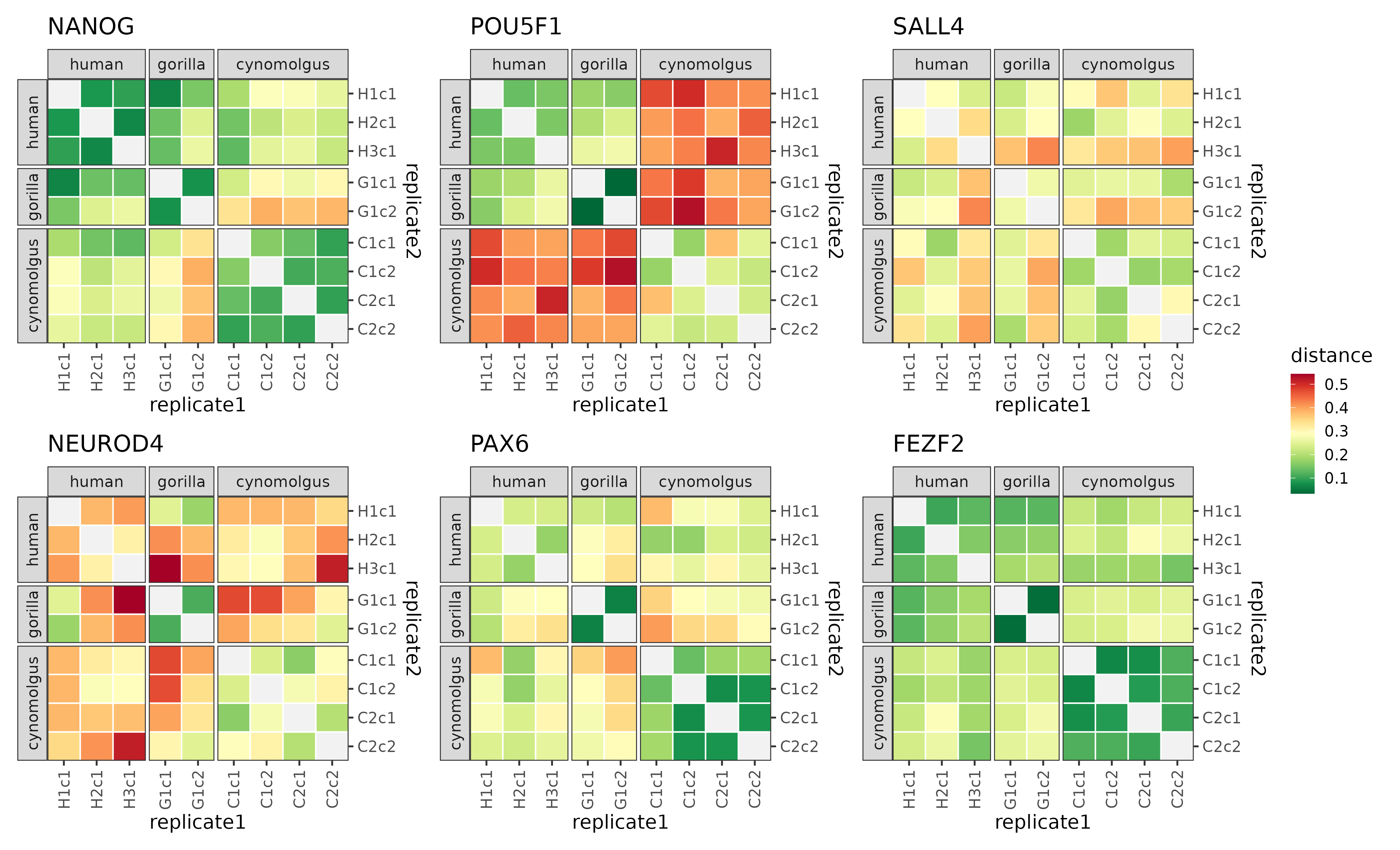
The distance matrices of 6 example modules.
It is apparent based on these six examples that the distance patterns vary quite a bit from module to module. Some modules (e.g. FEZF2) have in general low distance values which points to a high degree of preservation, while other modules (e.g. NEUROD4) tend to have higher distance values which points to a worse preservation. While for most modules the within-species distances are overall lower than the cross-species distances (this was a selection criteria for the preservation statistic after all), the magnitude of this difference is not constant: in case of the SALL4 module the within-species and cross-species scores span by and large a similar range, while in case of the POU5F1 module the ape-cynomolgus cross-species scores are drastically higher than the rest of the scores.
Tree reconstruction
To be able to quantitatively compare these different patterns of preservation, the distance measures are summarized as trees in the next step of the workflow. Each of the resulting trees stands for a single module (an original or jackknifed module version, if jackknifing is used): the tips represent the replicates and the branch lengths represent the dissimilarity of module topology between the networks of 2 replicates.
The trees are reconstructed using the neighbor-joining algorithm implemented by ape:nj. The function reconstructTrees is a wrapper around this, tailored for the specific purpose:
trees_jk <- reconstructTrees(dist_jk)
random_trees_jk <- reconstructTrees(random_dist_jk)
The output is a list of phylo objects per (jackknifed or original) module.
For visualizaton, it is again recommended to retrieve the trees of the original modules only:
Based on this list, the function plotTrees can visualize one or more module trees analogously to plotDistMats. Here we focus on the trees representations of the six example modules again:
spec_colors <- c(human = "#4DAF4A", gorilla = "#377EB8", cynomolgus = "#9a1ebd")
plotTrees(trees[example_modules], species_colors = spec_colors)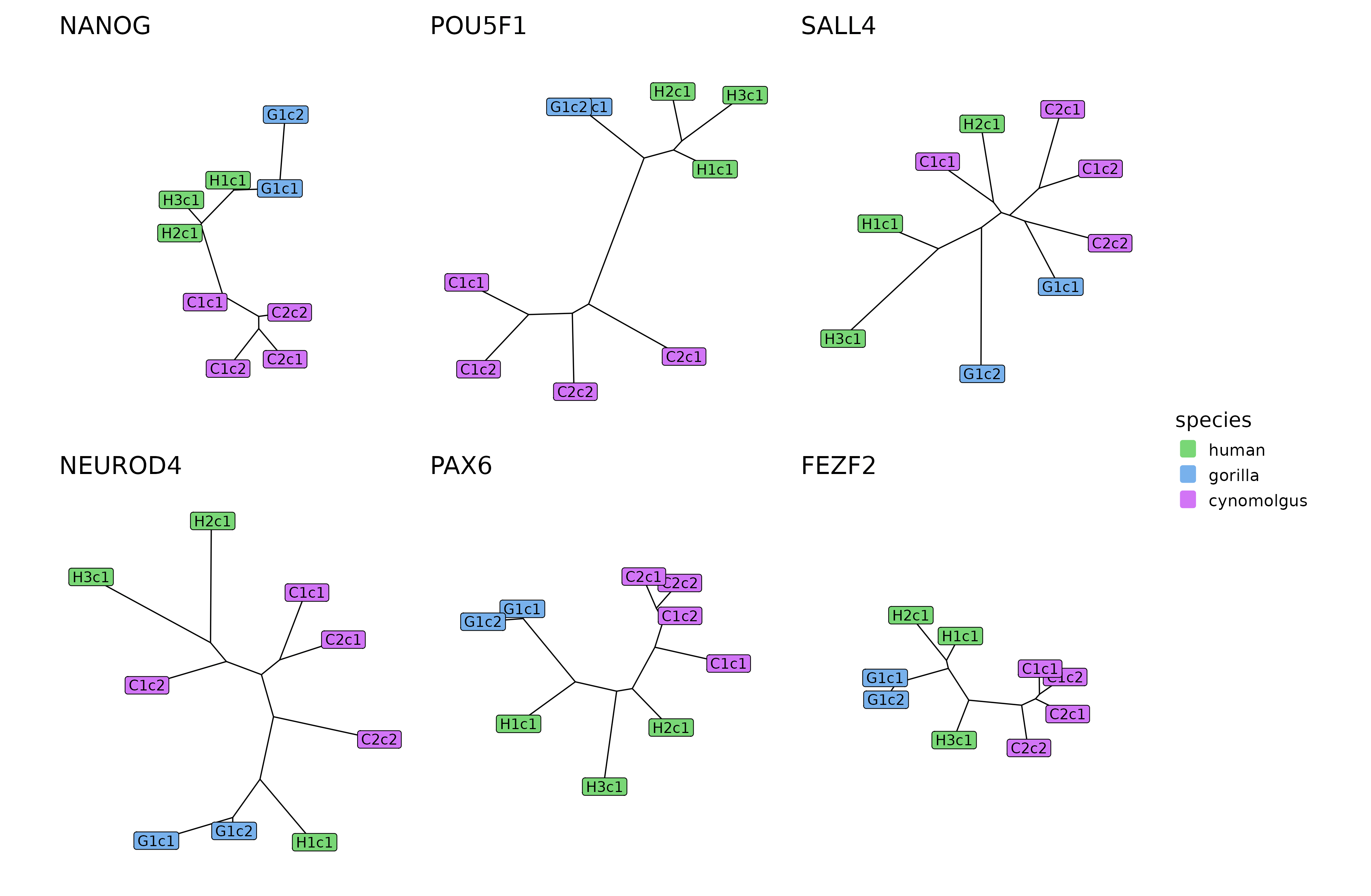
The tree reconstructions of 6 example modules.
In line with the differences among the distance matrices, the trees also differ from module to module. FEZF2, the module with generally low distance measures (i.e. high preservation scores), tends to have short branch lengths in its tree, while NEUROD4, the module with generally high distance measures (i.e. low preservation scores), has a large tree with long branches. In case of the SALL4 module that had similar within-species and cross-species distance measures, the replicates of different species are intermixed within the tree, while in case of the POU5F1 module that has much higher ape-cynomolgus distances than ape-ape or cynomolgus-cynomolgus distances, the ape and cynomolgus replicates are clearly separated within the tree and connected by a long internal branch.
Calculating tree-based statistics
To quantify these tell-tale characteristics of the module trees, various tree-based statistics can be calculated:
Total tree length: The sum of all branch lengths in the tree; measures module variability both within and across species.
Diversity of a species: The total length of the branches connecting the replicates of the given species to each other; measures module variability within this particular species.
Within-species diversity: The sum of the diversity values across all species; measures module variability within species in general.
Monophyleticity of a species: Indicates whether the tree is monophyletic for the replicates of the given species. Only if a module tree is monophyletic for a species of interest can the module be tested for divergence between this species and all others.
Subtree length of a species: The sum of the branch lengths in the subtree that is defined by the replicates of the species and includes the internal branch connecting these replicates to the rest of the tree (i.e. the lineage of interest). Undefined if the tree is not monophyletic for the species of interest.
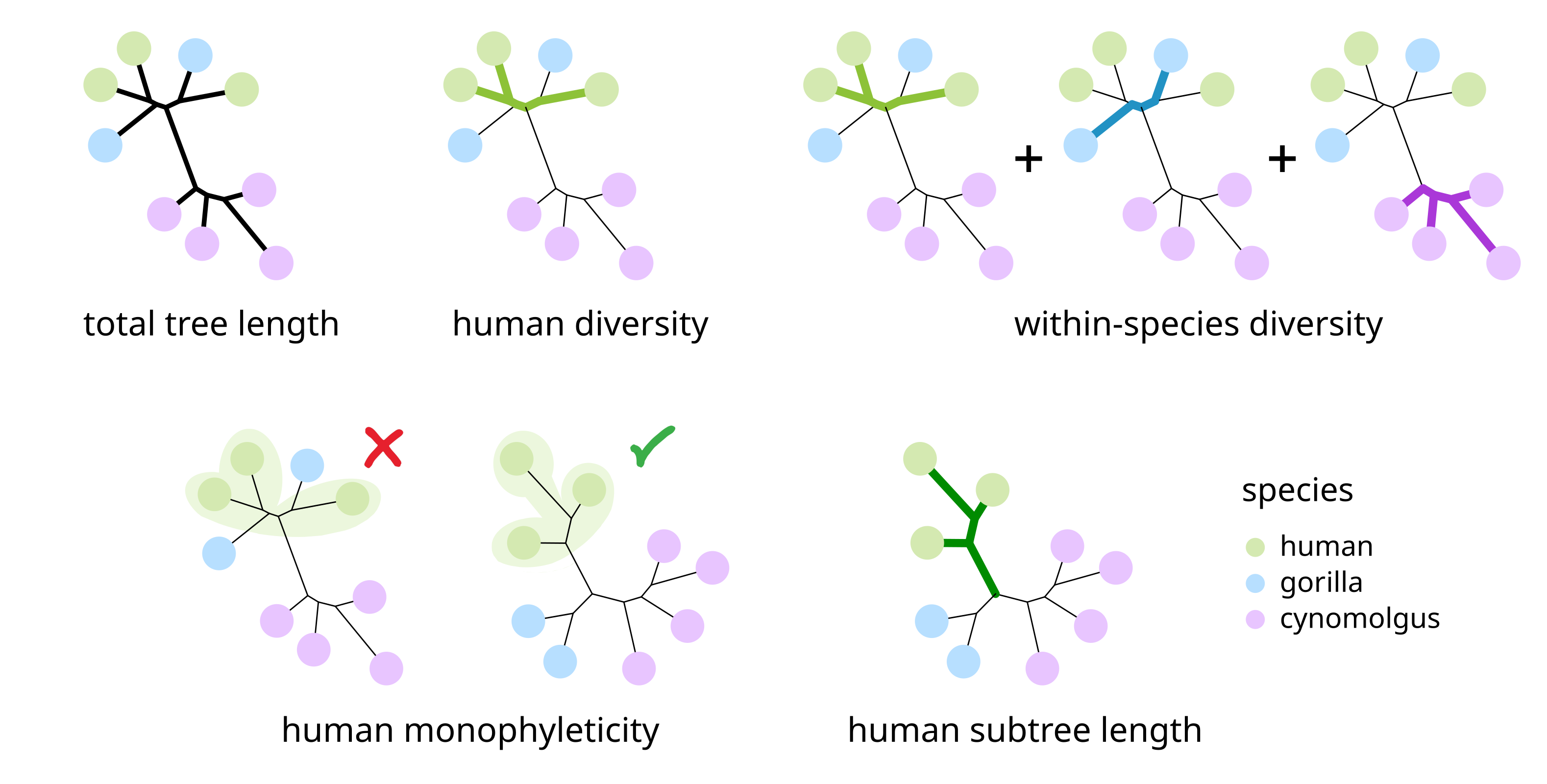
Tree-based statistics to characterize the cross-species conservation of network modules.
These statistics are all implemented in the function calculateTreeStats:
tree_stats_jk <- calculateTreeStats(trees_jk)
random_tree_stats_jk <- calculateTreeStats(random_trees_jk)| regulator | type | id | gene_ removed | total_ tree_length | within_species_ diversity | human_ diversity | gorilla_ diversity | cynomolgus_ diversity |
|---|---|---|---|---|---|---|---|---|
| POU5F1 | orig | POU5F1_orig | NA | 1.038 | 0.728 | 0.221 | 0.034 | 0.473 |
| POU5F1 | jk | POU5F1_jk_AP1S2 | AP1S2 | 1.042 | 0.724 | 0.220 | 0.034 | 0.470 |
| POU5F1 | jk | POU5F1_jk_APOE | APOE | 1.036 | 0.734 | 0.221 | 0.036 | 0.476 |
| POU5F1 | jk | POU5F1_jk_CD24 | CD24 | 1.038 | 0.733 | 0.225 | 0.039 | 0.469 |
| human_ monophyl | gorilla_ monophyl | cynomolgus_ monophyl | human_ subtree_length | gorilla_ subtree_length | cynomolgus_ subtree_length |
|---|---|---|---|---|---|
| TRUE | TRUE | TRUE | 0.258 | 0.120 | 0.661 |
| TRUE | TRUE | TRUE | 0.257 | 0.123 | 0.662 |
| TRUE | TRUE | TRUE | 0.256 | 0.113 | 0.666 |
| TRUE | TRUE | TRUE | 0.261 | 0.128 | 0.649 |
Similarly to the preservation statistics, the tree-based statistics can also be summarized over all jackknifed version of a module to obtain an overall estimate along with a confidence interval:
tree_stats <- summarizeJackknifeStats(tree_stats_jk,
                                      c("total_tree_length",
                                        "within_species_diversity",
                                        "human_branch_length",
                                        "human_diversity"))
random_tree_stats <- summarizeJackknifeStats(random_tree_stats_jk,
                                             c("total_tree_length",
                                               "within_species_diversity",
                                               "human_branch_length",
                                               "human_diversity"))
Quantifying cross-species conservation of network modules
After having calculated first pairwise preservation scores between replicates and then higher-level tree-based statistics to characterize how different the topologies of the modules are within and across species, we are ready to quantify the evolutionary conservation of modules. But why do we need the within-species differences in the first place? Why is the extent of cross-species differences not directly the answer to evolutionary conservation?
There are several sources of module topological differences when we compare two species: there is of course true evolutionary divergence between the species which is what we are primarily interested in, but this is convoluted with genetic diversity across individuals of the same species, environmental factors and technical noise. In the end, if we find that the topology of a module is different between two species, it is difficult to say to what extent it is actually due to divergence. This is why the within-species differences also become valuable sources of information: they provide an estimate of the variability originating from confounding sources and thus can be used to discern the signal of real divergence.
Overall conservation and divergence
To apply this concept for the quantification of overall conservation across all species, we used two tree-based statistics: within-species diversity and total tree length. The two metrics are based on the same trees and calculated using in part the same branches, so they are clearly not independent. Their general relationship can be captures by linear regression, that in biological terms describes which part of the total module variability is due to the confounding factors (genetic inter-individual differences, environmental and technical noise).
Filtering the module trees
Where a module is located along the regression line informs us about detection robustness. Modules that have both low within-species diversity and low total tree length are well-preserved both within and across species, meaning that these modules could be robustly detected in all replicates, whereas modules, for which both metrics are high, are poorly preserved not just across but also within species, indicating a high detection uncertainty (“wobbliness”).
The general trend between the within-species diversities and total tree lengths can be visualized using the function plotTreeStats. In the plot below, both the actual and the random modules are included:
plotTreeStats(tree_stats,
              random_tree_stats,
              c("within_species_diversity", "total_tree_length"))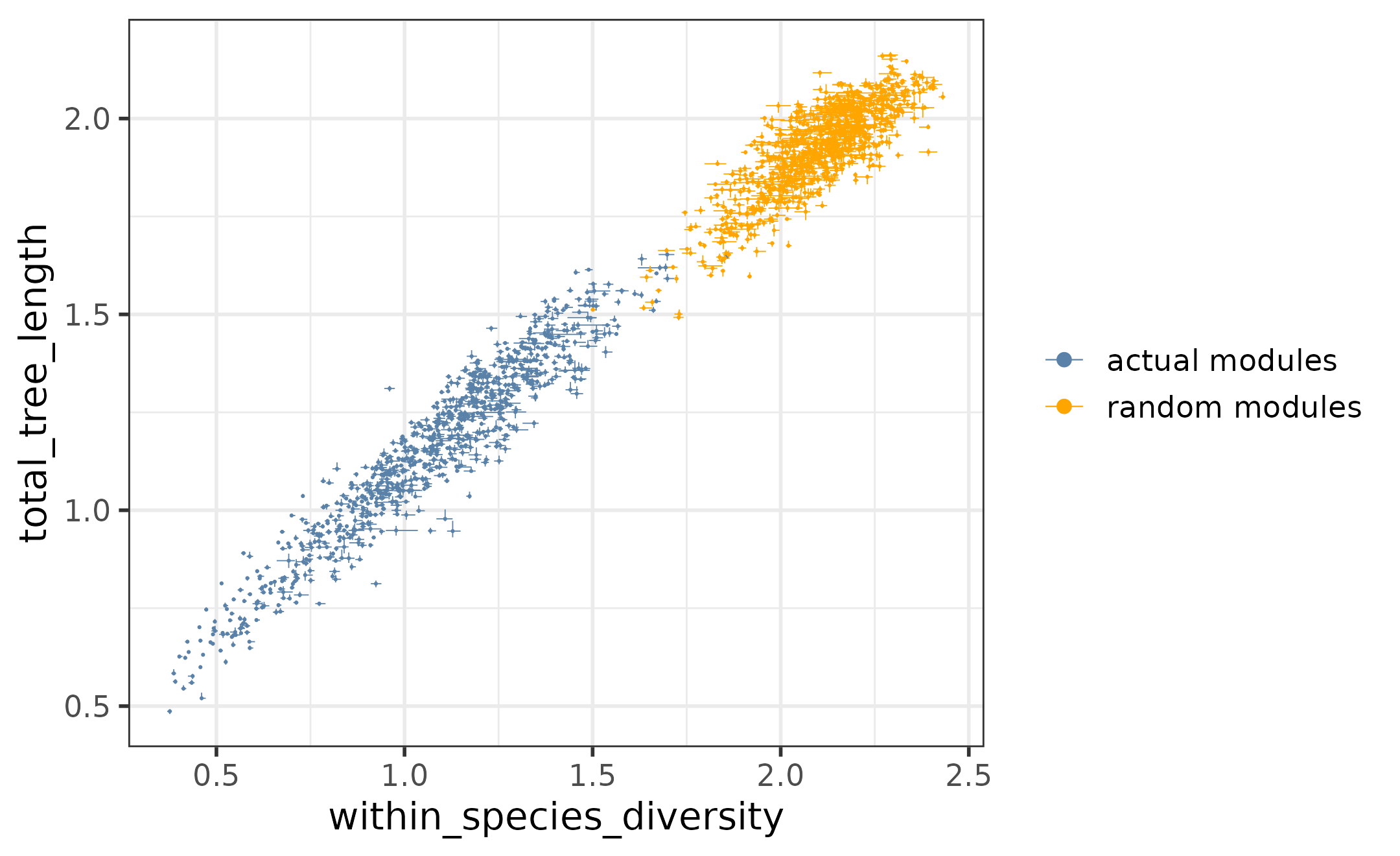
The relationship of the total tree lengths and within-species diversities across all actual and random modules.
As we have seen before, the within-species diversities and total tree lengths are in general higher for the random modules than for the actual modules - thus the random modules cluster separately on the plot at the “wobbly” end of the spectrum. However, there are still individual actual modules that have particularly high total tree lengths and within-species diversities, comparable with those of the random modules. Since the tree properties of these modules are likely dominated by technical and environmental noise, it is recommended to remove them for further analysis.
The function filterModuleTrees calculates how probable it is that the statistics of an actual comes from the distribution of all actual modules () and how probable it is that the statistics comes from the distribution of all random modules () using the probability density functions of the two bivariate normal distributions. If
is fulfilled for both tree statistics, the module is kept, otherwise it is removed.
tree_stats_filt <- filterModuleTrees(tree_stats, random_tree_stats)In case of the example dataset, this filtering removes 10 modules (marked in red):
plotTreeStats(tree_stats,
              random_tree_stats,
              c("within_species_diversity", "total_tree_length")) +
  geom_point(data = dplyr::anti_join(tree_stats, tree_stats_filt), color = "red3", size = 1.2)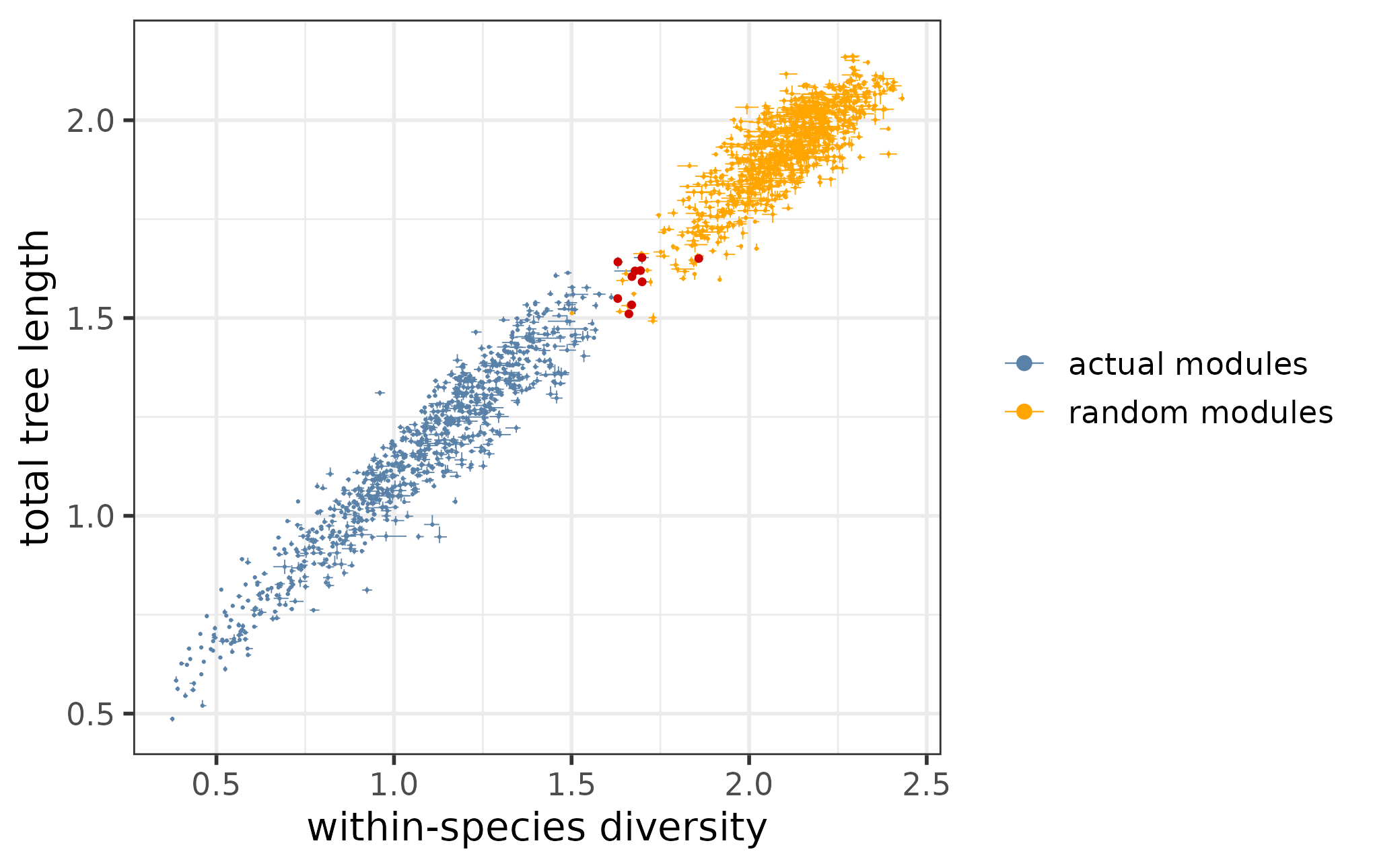
The relationship of the total tree lengths and within-species diversities across all actual and random modules, with the removed actual modules marked.
Finding conserved and diverged modules
After removing these “wobbly” modules, cross-species conservation can be quantified using the residuals of the linear regression model. These residuals from the regression line reflect the variance of the total tree length that cannot be explained by within-species diversity, i.e. the contribution of true evolutionary divergence to the total module variability. Positive residuals correspond to a greater-than-expected contribution and negative residuals to a lower-than-expected contributions, respectively. In order to identify modules with significant deviations from the overall trend, we calculate the 95% prediction interval of the linear fit and considered modules above the upper bound of the prediction interval diverged and the modules below the lower bound of the prediction interval conserved.
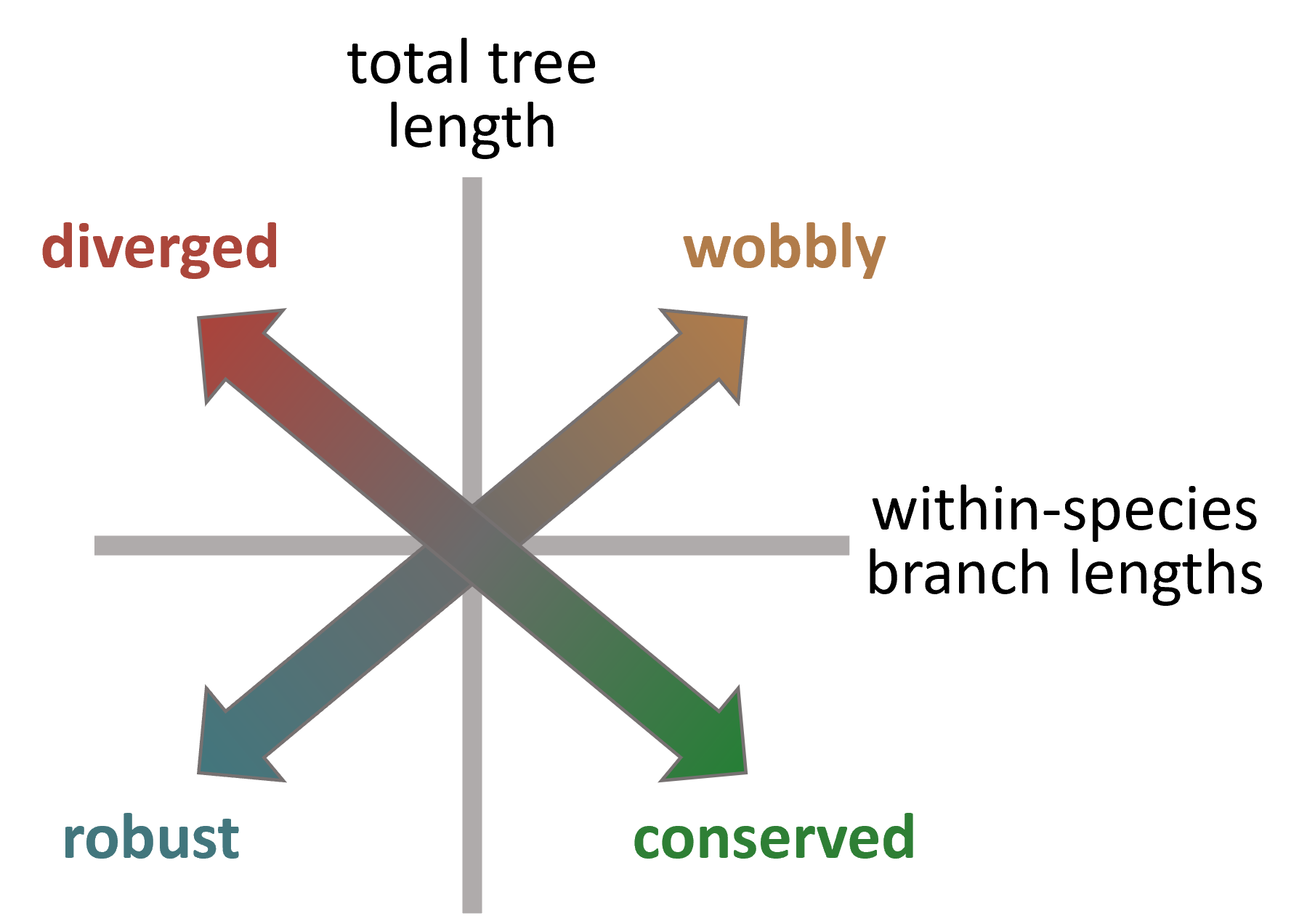
The concept of using tree-based statistics to puzzle apart conserved, diverged, robust and wobbly modules.
The function fitTreeStatsLm fits a regression model between the two statistics and the function findConservedDivergedModules identifies conserved and diverged modules by comparing each module’s residual to the 95% prediction interval of the fit.
The linear regression can be weighted by the error of the data points derived from jackknifing. If this option is chosen (weighted_lm is set to TRUE), the weight of a module in the regression is defined as inversely proportional to the total tree length variance across all of its jackknifed module versions.
In case of the example dataset, we used a weighted linear regression:
lm_overall <- fitTreeStatsLm(tree_stats_filt,
                             focus = "overall",
                             weighted_lm = TRUE)
module_conservation_overall <- findConservedDivergedModules(tree_stats_filt,
lm_overall)| focus | regulator | module_ size | total_ tree_length | lwr_total_ tree_length | upr_total_ tree_length | within_species_ diversity | lwr_within_ species_diversity |
|---|---|---|---|---|---|---|---|
| overall | NANOG | 42 | 0.599 | 0.596 | 0.604 | 0.457 | 0.456 |
| overall | POU5F1 | 46 | 1.036 | 1.033 | 1.042 | 0.730 | 0.726 |
| overall | SALL4 | 40 | 1.130 | 1.120 | 1.143 | 1.191 | 1.173 |
| overall | NEUROD4 | 52 | 1.208 | 1.200 | 1.214 | 1.254 | 1.240 |
| overall | PAX6 | 48 | 0.798 | 0.794 | 0.804 | 0.643 | 0.639 |
| overall | FEZF2 | 40 | 0.560 | 0.554 | 0.567 | 0.434 | 0.426 |
| upr_within_ species_diversity | fit | lwr_fit | upr_fit | residual | weight | t_score | conservation |
|---|---|---|---|---|---|---|---|
| 0.461 | 0.654 | 0.571 | 0.737 | -0.055 | 0.003 | -1.296 | not_significant |
| 0.733 | 0.881 | 0.815 | 0.946 | 0.156 | 0.004 | 4.650 | diverged |
| 1.204 | 1.264 | 1.092 | 1.437 | -0.134 | 0.001 | -1.533 | not_significant |
| 1.262 | 1.317 | 1.178 | 1.456 | -0.109 | 0.001 | -1.545 | not_significant |
| 0.647 | 0.808 | 0.733 | 0.884 | -0.011 | 0.003 | -0.274 | not_significant |
| 0.442 | 0.635 | 0.523 | 0.746 | -0.075 | 0.001 | -1.324 | not_significant |
Using this approach, we identified 20 conserved and 24 diverged modules:
table(module_conservation_overall$conservation)
#>
#>       conserved        diverged not_significant
#>              21              23             788
The function plotConservedDivergedModules helps to visualize the regression line, its 95% prediction interval (grey area), and the conserved and diverged modules (colored green and red, respectively). It also labels the top N most conserved and most diverged modules. In the plot below, the top 5 most conserved and most diverged modules based on residuals are highlighted:
plotConservedDivergedModules(module_conservation_overall,
                             N = 5)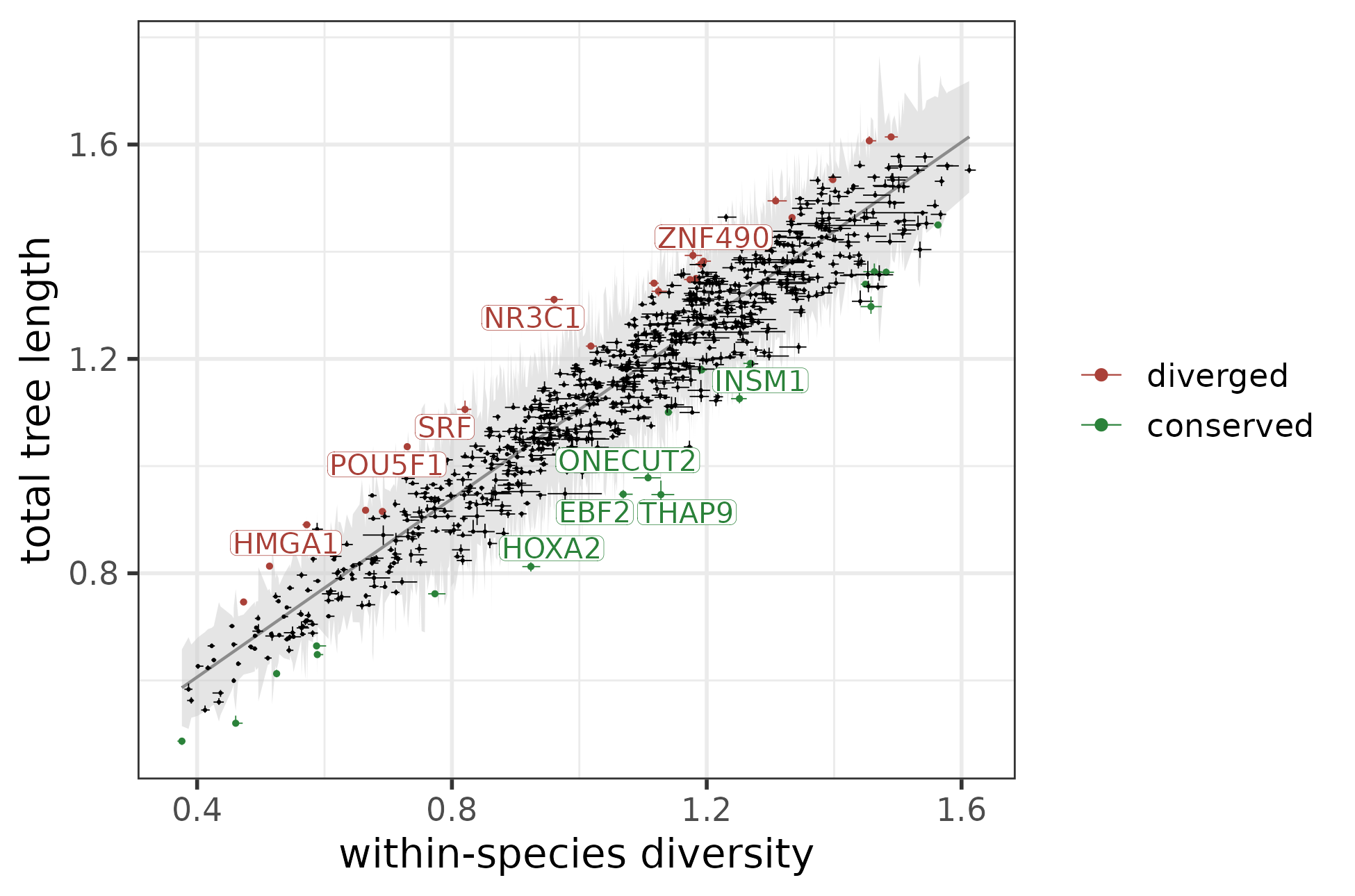
Weighted linear regression between the total tree length and within-species diversity, with the top 5 most conserved and most diverged modules marked.
To illustrate what makes these modules conserved or diverged, their distance matrices and module trees can also be plotted:
top5_cons_div_modules <- bind_rows(module_conservation_overall %>%
                                    dplyr::filter(conservation == "conserved") %>%
                                    dplyr::slice_min(order_by = residual, n = 5),
                                   module_conservation_overall %>%
                                    dplyr::filter(conservation == "diverged") %>%
                                    dplyr::slice_max(order_by = residual, n = 5)) %>%
  dplyr::pull(regulator)
plotDistMats(dist[top5_cons_div_modules], ncol = 5)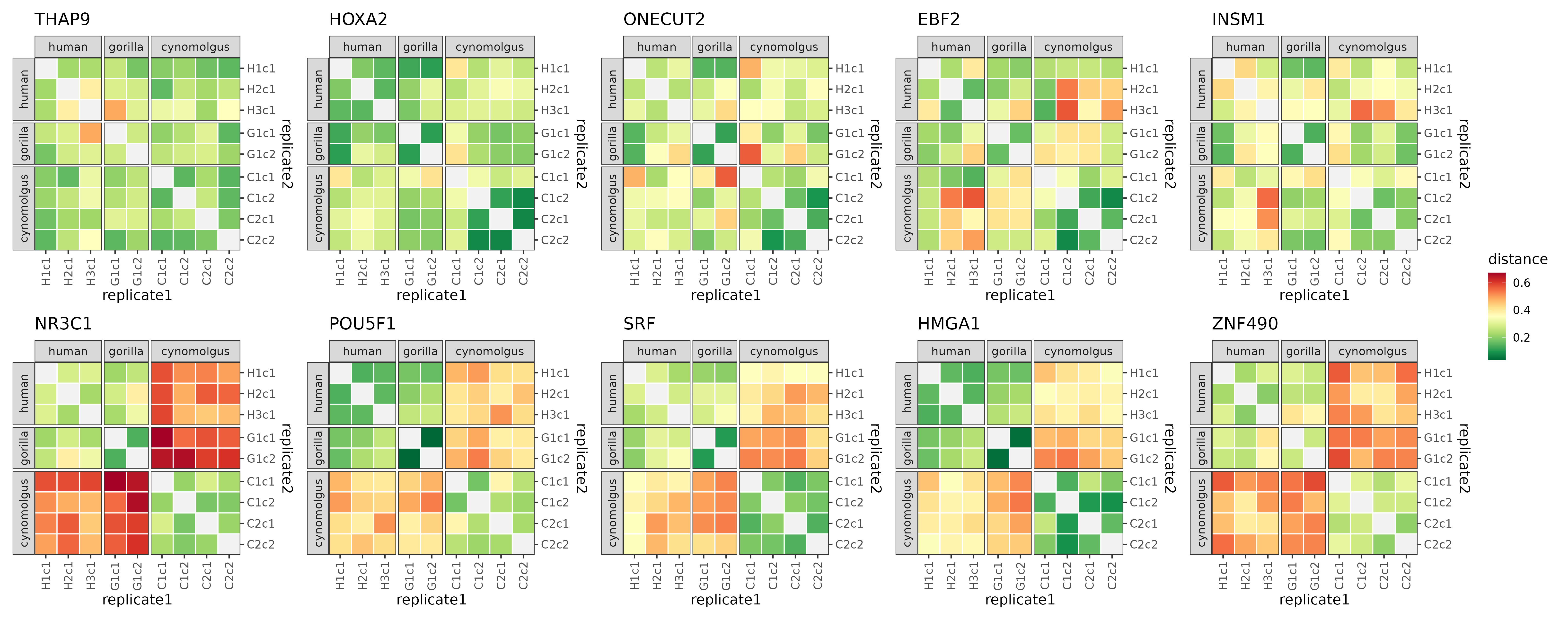
The distance matrices of the 5 most conserved (top row) and 5 most diverged (bottom row) modules.
plotTrees(trees[top5_cons_div_modules], species_colors = spec_colors, ncol = 5)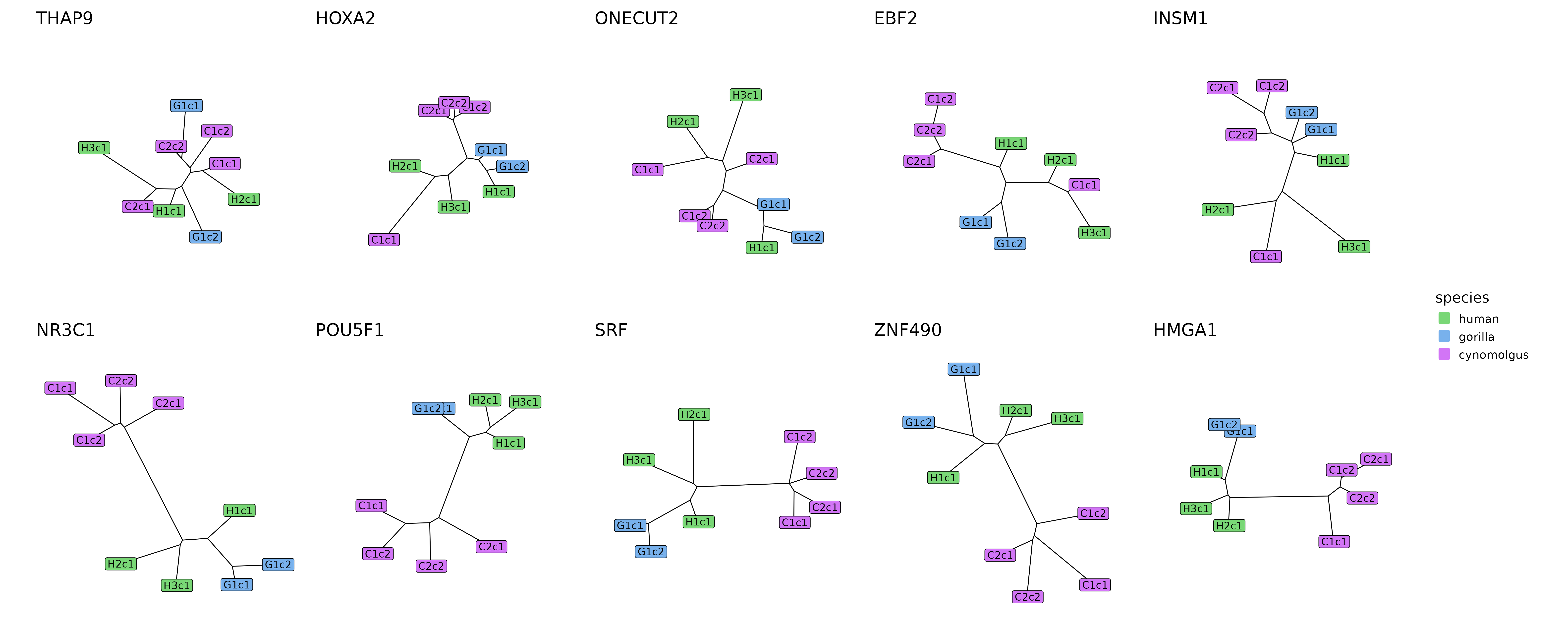
The tree reconstructions of the 5 most conserved (top row) and 5 most diverged (bottom row) modules.
The contrast between the conserved and diverged modules in terms of their distance matrices and module trees is clearly visible. The conserved modules tend to have balanced distance matrices with similarly low distance measures for all within-species and cross-species comparisons, and correspondingly, tree reconstructions without any species separation, with replicates from the same species being as close to each other as replicates from different species.
In contrast, diverged modules tend to have much higher distance measures across species than within species for 1 or more species pairs (in case of the example modules it is always the human-cynomolgus and gorilla-cynomolgus species pairs). This also results in trees where these species are strikingly distinct, with short branches within the species or clades and a long internal branch separating these subtrees from each other.
Finding conserved and diverged edges
A divergence score can be calculated not just for a module as a whole, but also for each edge within a module, which can pinpoint individual edges or regions of neighboring edges that are particularly conserved or diverged. This score is calculated based on the different weights of a given edge in the networks of the different replicates. The edge weights are compared across species using an ANOVA, and the log10 of the F-statistic (i.e. between-species variability / within-species variability) is regarded as the measure of edge divergence.
These scores can be returned as a data frame using calculateEdgeDivergence or directly plotted using plotNetworks with color_by set to “edge_divergence”. Below we plot the 300 strongest edges within each of the 5 most conserved and most diverged modules colored by edge divergence:
plotNetworks(top5_cons_div_modules,
             pruned_modules,
             consensus_network,
             network_list,
             replicate2species,
             color_by = "edge_divergence",
             ncol = 5)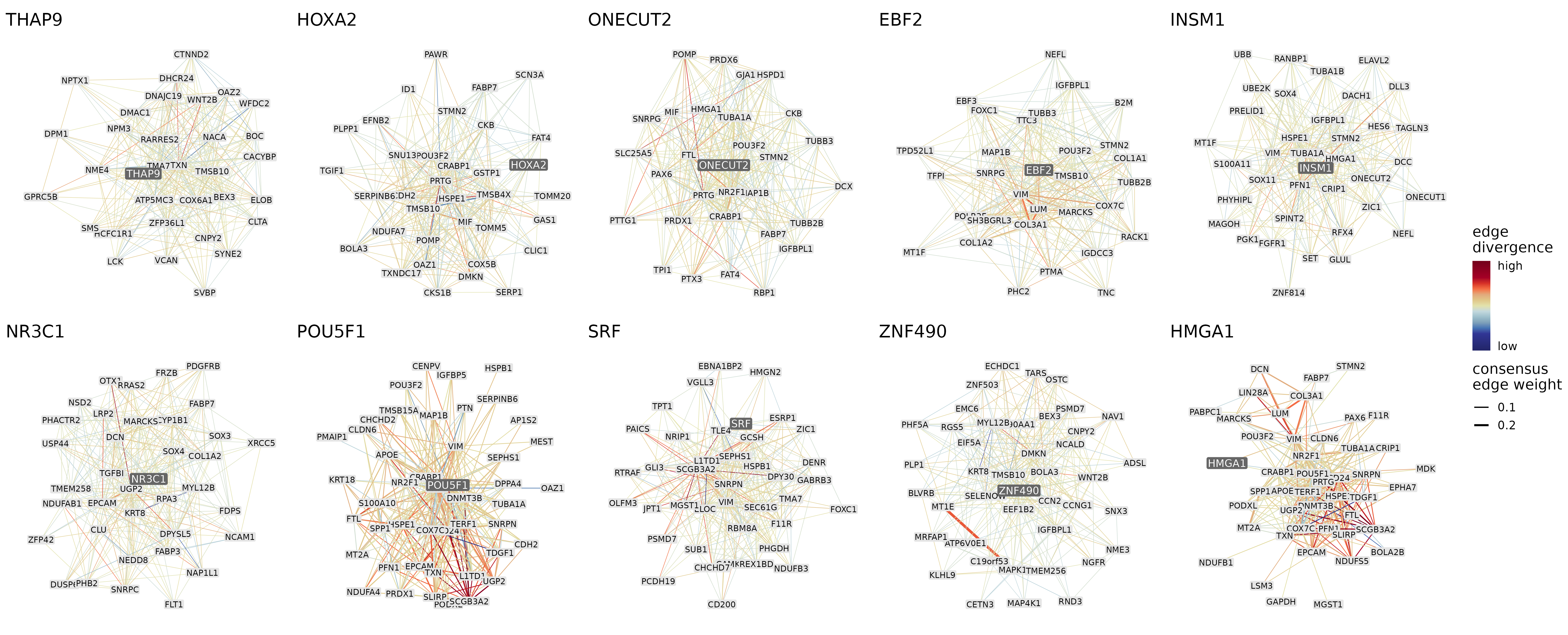
The 300 strongest connections of the 5 most conserved (top row) and 5 most diverged (bottom row) modules. The thickness of the edges represents the consensus edge weights and the color of the edges represents how different the mean edge weights are across the 3 species.
Based on the network visualizations, the diverged modules (especially HMGA1 and POU5F1) tend to have more diverged edges than the conserved modules, which confirms the previous findings from a different aspect. The genes that form the most diverged edges within a module can also be pinned down, for example in case of the POU5F1 module, SCGB3A2 is the main hub for these diverged edges.
Finding conserved and diverged target genes
Genes that contribute the most to the conservation/divergence of a module can be identified not just using the edge divergence scores, but also based on jackknifing.
During jackknifing, each member gene of a module is removed and all statistics are recalculated, including the tree-based statistics (total tree length and within-species diversity) that inform us about cross-species conservation. Our working hypothesis is that if removing a target gene from a diverged module makes the module more conserved, then that target was responsible for divergence in the original module, and vice versa, if removing a target gene from a conserved module makes the module more diverged, then that target was responsible for conservation in the original module.
To quantify these effects, the function findConservedDivergedTargets makes use of the linear model that was fitted across all modules between the total tree length and within-species diversity and that was used to identify the conserved and diverged modules in the first place. However, in this case we calculated a residual for each jackknifed module version separately () and compared these residuals to the residual of the original, complete module () in order to derive a target gene contribution score ():
A positive score indicates that removing the target gene weakens the signal of conservation or divergence, while a negative score means that after jackknifing the signal becomes stronger. Thus, the most diverged targets in a diverged module and the most conserved targets in a conserved module both get high positive scores. In extreme cases, the score could reach or exceed 1, which means that the removal of a single target gene would abolish or even reverse the signal. However, in most cases the detected signal is expected to originate from the joint contribution of many genes (this was the case for all modules except one in our example dataset).
We calculated the target contribution scores for the five most conserved and five most diverged modules:
target_contributions_overall <- foreach(module = top5_cons_div_modules,
                                        .combine = bind_rows) %do% {

                                          findConservedDivergedTargets(module, tree_stats_jk, lm_overall)

}| focus | regulator | type | id | gene_ removed | within_species_ diversity |
|---|---|---|---|---|---|
| overall | POU5F1 | orig | POU5F1_orig | NA | 0.728 |
| overall | POU5F1 | jk | POU5F1_jk_AP1S2 | AP1S2 | 0.724 |
| overall | POU5F1 | jk | POU5F1_jk_APOE | APOE | 0.734 |
| overall | POU5F1 | jk | POU5F1_jk_CD24 | CD24 | 0.733 |
| total_ tree_length | fit | lwr_fit | upr_fit | residual | contribution |
|---|---|---|---|---|---|
| 1.038 | 0.879 | 0.813 | 0.945 | 0.159 | NA |
| 1.042 | 0.876 | 0.810 | 0.942 | 0.166 | -0.045 |
| 1.036 | 0.884 | 0.818 | 0.949 | 0.152 | 0.041 |
| 1.038 | 0.883 | 0.817 | 0.949 | 0.155 | 0.023 |
We plotted the scores to identify the most impactful target genes in each module:
target_contributions_overall %>%
  dplyr::filter(type == "jk") %>%
  inner_join(module_conservation_overall %>% dplyr::select(regulator, conservation)) %>%
  dplyr::mutate(regulator = factor(regulator, top5_cons_div_modules)) %>%
  group_by(regulator) %>%
  dplyr::mutate(to_label = ifelse(contribution %in% sort(contribution, decreasing = TRUE)[1:2], unique(conservation), "no_label")) %>%
  ggplot(aes(x = regulator, y = contribution, color = to_label)) +
  geom_quasirandom(aes(size = to_label)) +
  theme_bw() +
  scale_size_manual(values = c("diverged" = 0.8, "conserved" = 0.8, "no_label" = 0.5), guide = "none") +
  scale_color_manual(values = c("conserved" = "#2B823A", "diverged" = "#AA4139", "no_label" = "black"), guide = "none") +
  geom_label_repel(data = . %>%
                     dplyr::filter(to_label != "no_label"),
                   ggplot2::aes(label = gene_removed),
                   fill = "white", size = 2.5, label.size = 0.08, segment.size = 0.08, box.padding = 0.05, label.padding = 0.05) +
  ylab("target gene contribution") +
  theme(axis.title.x = element_blank(),
        axis.text.x = element_text(size = 10.5, color = "black"))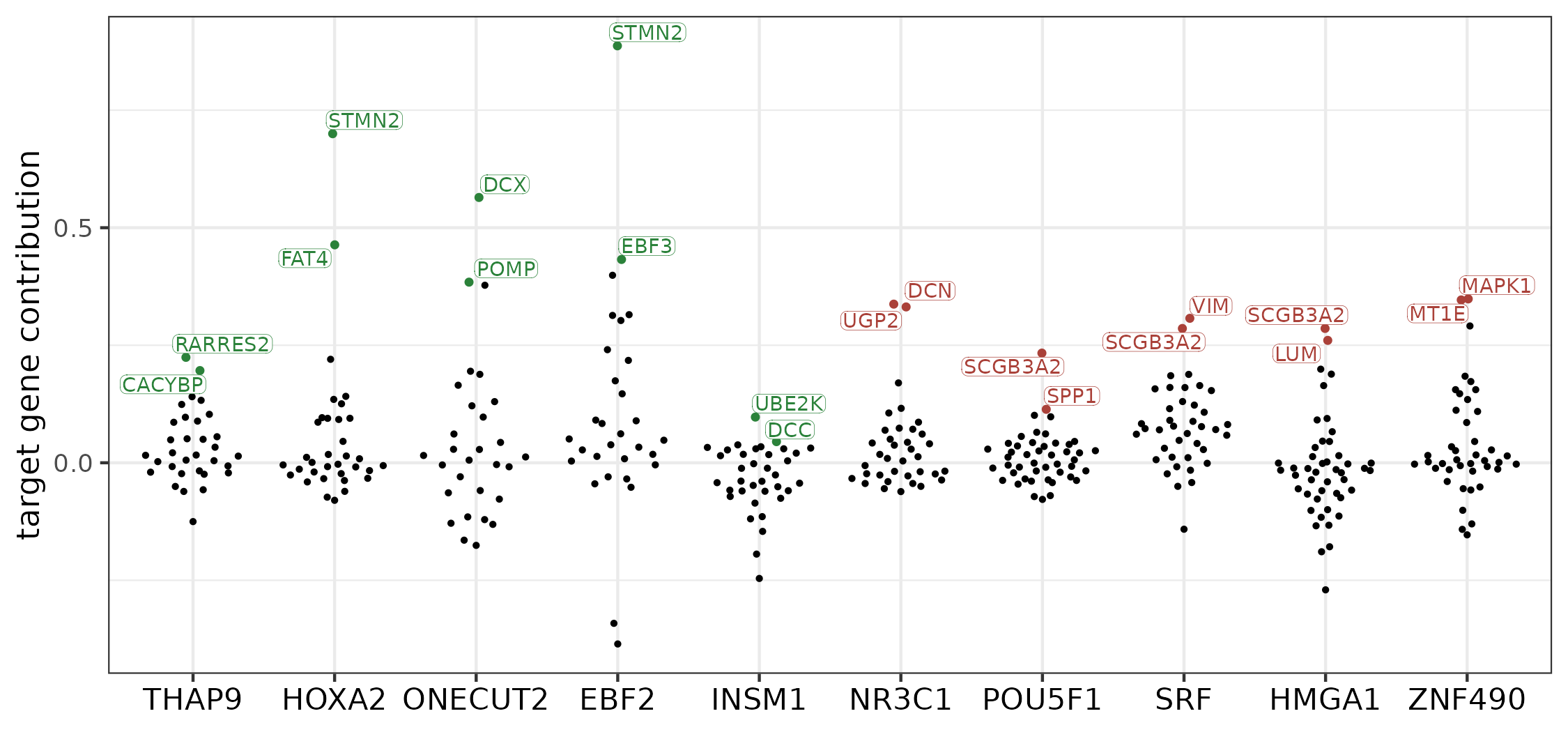
Contribution scores of the target genes in the five most conserved (in green) and five most diverged (red) modules. The two top-contributing targets are labeled for each module.
We took a closer look at the POU5F1 module and plotted the original and jackknifed versions along the regression line with the help of the function plotConservedDivergedTargets:
plotConservedDivergedTargets(target_contribution_POU5F1)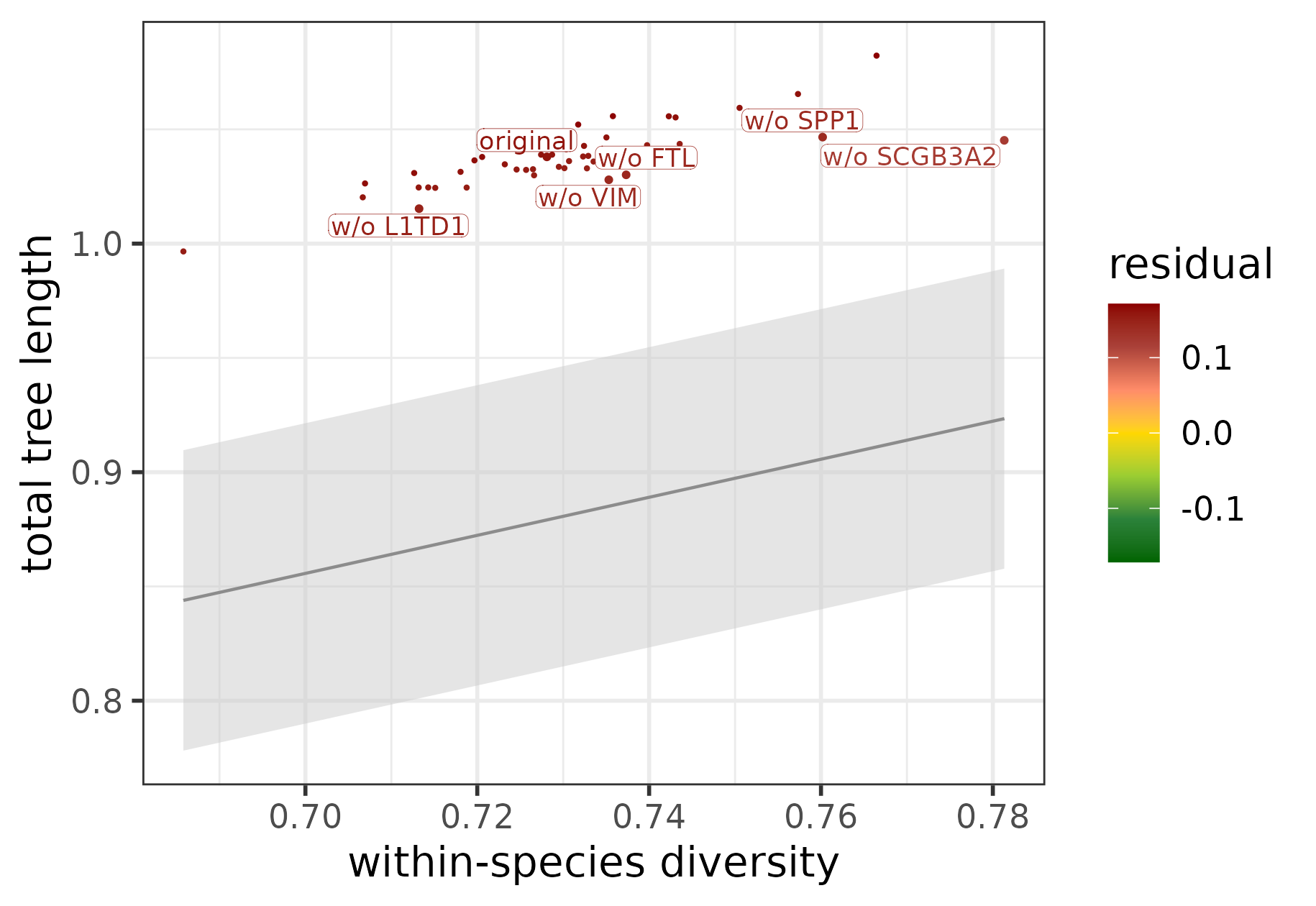
The five most diverged target genes of POU5F1 identified using tree-based statistics in combination with jackknifing.
All jackknifed versions are located way outside the prediction interval, meaning that the whole module exhibits a strong signal of divergence that cannot be explained by any of the target genes alone. The most diverged target with the highest contribution score is SCGB3A2, in line with the findings based on edge divergence.
To investigate whether the network divergence/conservation also translates into expression divergence/conservation, the expression profiles of the regulator and its targets can be plotted per species using plotExprAlongPseudotime (for pseudotime trajectories) or plotExprPerCellType (for distinct cell types). Below, we plot the expression of POU5F1 and its 5 most diverged target genes across the pseudotime range of the neural differentiation process:
top5_diverged_POU5F1_targets <- target_contributions_POU5F1 %>%
  slice_min(order_by = residual, n = 5) %>%
  pull(gene_removed)
ct_colors <- c(Pluripotent_Cells = "#86C1E6", Early_Ectoderm = "#F4AB62", Neurons = "#CA6102")
plotExprAlongPseudotime(c("POU5F1", top5_diverged_POU5F1_targets),
                        sce,
                        species_colors = spec_colors,
                        cell_type_colors = ct_colors)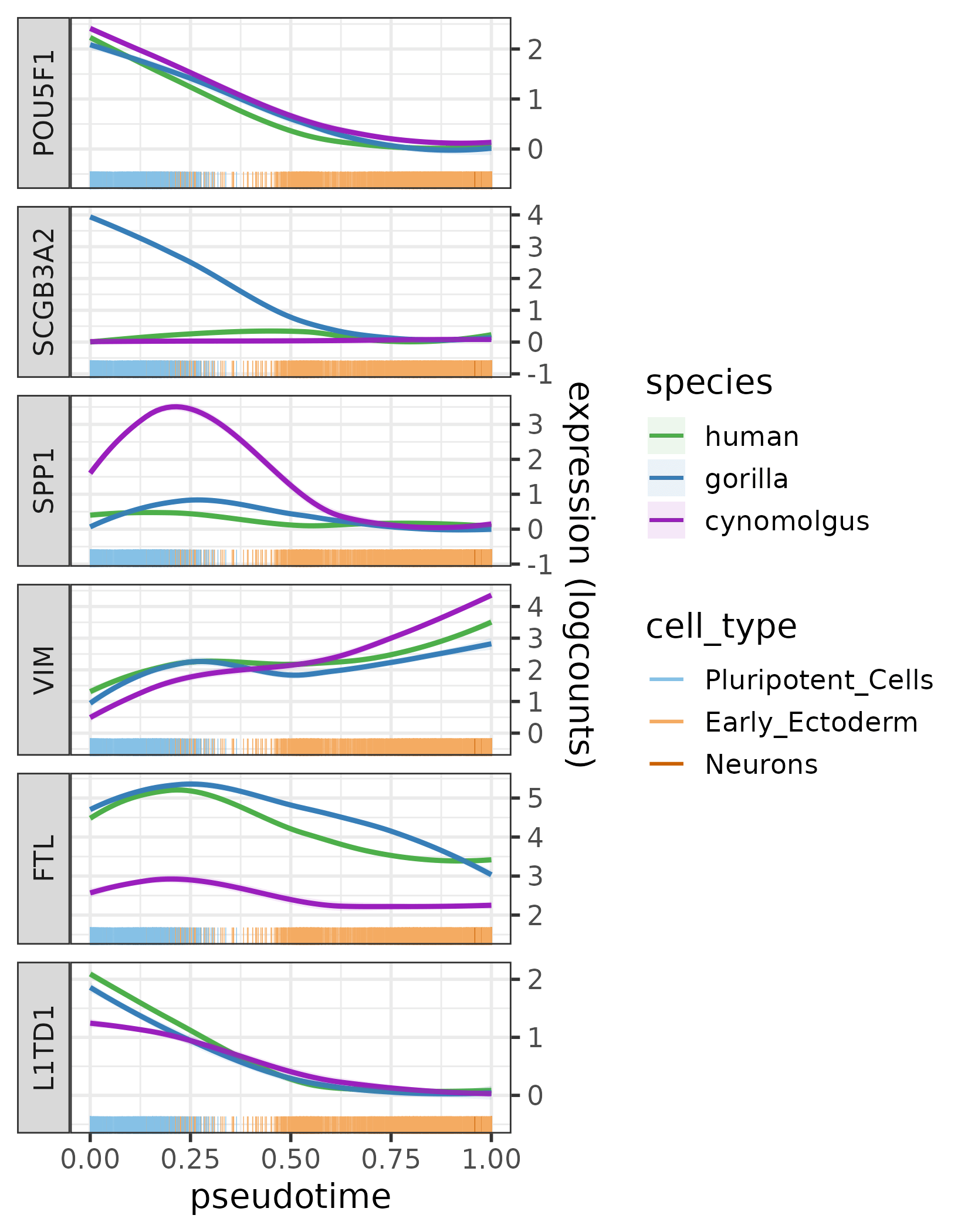
The expression profiles of POU5F1 and its five most diverged target genes across the pseudotime trajectory per species.
Several target genes of POU5F1 that are diverged in terms of network topology (SCGB3A2, SPP1 and FTL) also show different expression patterns across species. Such differences cannot be observed for POU5F1, the regulator itself — a hint toward cis-regulatory changes. Indeed, after a more thorough investigation we found that both SCGB3A2 and SPP1 are known to be located close to LTR7 elements in the human genome [25, 26], an evolutionary young family of transposable elements that often harbor binding sites for pluripotency factors. The LTR7 elements near these two genes appeared along the ape lineage and are bound by POU5F1 [27], so they could have potentially contributed to the rewiring of the POU5F1 module.
Lineage-specific divergence
The approach described above characterizes the overall degree of module conservation - all species within a tree are treated the same. This is the most suitable approach for finding conserved modules and for finding the highest signal of divergence irrespective of phylogeny. In case of the example dataset, most of the diverged modules detected this way are diverged between cynomolgus macaques and great apes (rather than within the great apes) simply because longer phylogenetic distances generally give rise to bigger differences.
In many cases, however, the primary interest lies in divergence on a particular lineage, e.g. the human lineage. To address this, we define the human lineage as the branch leading from the most recent common ancestor (MRCA) of humans and gorillas to the human MRCA, using the macaque as an outgroup. A minimal requirement for this analysis is that the human replicates form a monophyletic group; trees that don’t fulfill this requirement are excluded. The human subtree is then defined as the subtree that includes all human replicates and the human lineage. To again correct for the unwanted sources of variation, this subtree length is contrasted against variation within the lineage, i.e. the human diversity. This allows us to assess module divergence specifically on the human lineage. An analogous approach can be applied to find diverged modules on any lineage of interest where an outgroup can be defined.
Finding conserved and diverged modules
The modules that are diverged on the human lineage can be defined using a (weighted) linear regression between the human subtree length and the human diversity, implemented in fitTreeStatsLm with focus set to “human” and findConservedDivergedModules. Similarly to the overall conservation and divergence, the 95% prediction interval of the regression line is calculated and the modules that have a higher human subtree length than the upper bound of the 95% prediction interval are considered diverged. It is important to note that the modules that fall below the lower bound of the 95% prediction interval cannot be interpreted as conserved in this case, because 1) the human-monophyletic module trees have already been pre-selected, and 2) conservation is by definition not a lineage-specific feature.
Below, this approach is applied to the example dataset:
lm_human <- fitTreeStatsLm(tree_stats_filt,
                           focus = "human",
                           weighted_lm = TRUE)
module_conservation_human <- findConservedDivergedModules(tree_stats_filt,
lm_human)| focus | regulator | module_ size | human_ subtree_length | lwr_human_subtree_ length | upr_human_subtree_ length | human_ diversity |
|---|---|---|---|---|---|---|
| human | AR | 39 | 0.362 | 0.359 | 0.367 | 0.335 |
| human | ARID1B | 43 | 0.426 | 0.423 | 0.434 | 0.338 |
| human | ARID2 | 48 | 0.330 | 0.324 | 0.335 | 0.304 |
| human | BNC2 | 49 | 0.319 | 0.316 | 0.324 | 0.286 |
| human | CREB3 | 49 | 0.352 | 0.349 | 0.354 | 0.313 |
| human | E2F3 | 46 | 0.390 | 0.385 | 0.395 | 0.355 |
| lwr_human_ diversity | upr_human_ diversity | fit | lwr_fit | upr_fit | residual | weight | t_score | conservation |
|---|---|---|---|---|---|---|---|---|
| 0.331 | 0.339 | 0.377 | 0.338 | 0.416 | -0.015 | 0.010 | -0.786 | not_significant |
| 0.336 | 0.342 | 0.380 | 0.338 | 0.422 | 0.046 | 0.009 | 2.194 | diverged |
| 0.300 | 0.308 | 0.343 | 0.311 | 0.376 | -0.013 | 0.014 | -0.800 | not_significant |
| 0.282 | 0.291 | 0.324 | 0.295 | 0.354 | -0.005 | 0.018 | -0.346 | not_significant |
| 0.311 | 0.317 | 0.354 | 0.324 | 0.383 | -0.002 | 0.018 | -0.148 | not_significant |
| 0.352 | 0.360 | 0.398 | 0.366 | 0.429 | -0.008 | 0.016 | -0.517 | not_significant |
In total, there are 57 modules that fulfill the minimum criteria of being monophyletic for the human replicates:
nrow(module_conservation_human)
#> [1] 57
Among these, we identified three modules that are diverged on the human lineage:
table(module_conservation_human$conservation)
#>
#>        diverged not_significant
#>               2              55
The results can also be plotted using plotConservedDivergedModules, the same function that has already been used in case of the overall conservation and divergence:
plotConservedDivergedModules(module_conservation_human)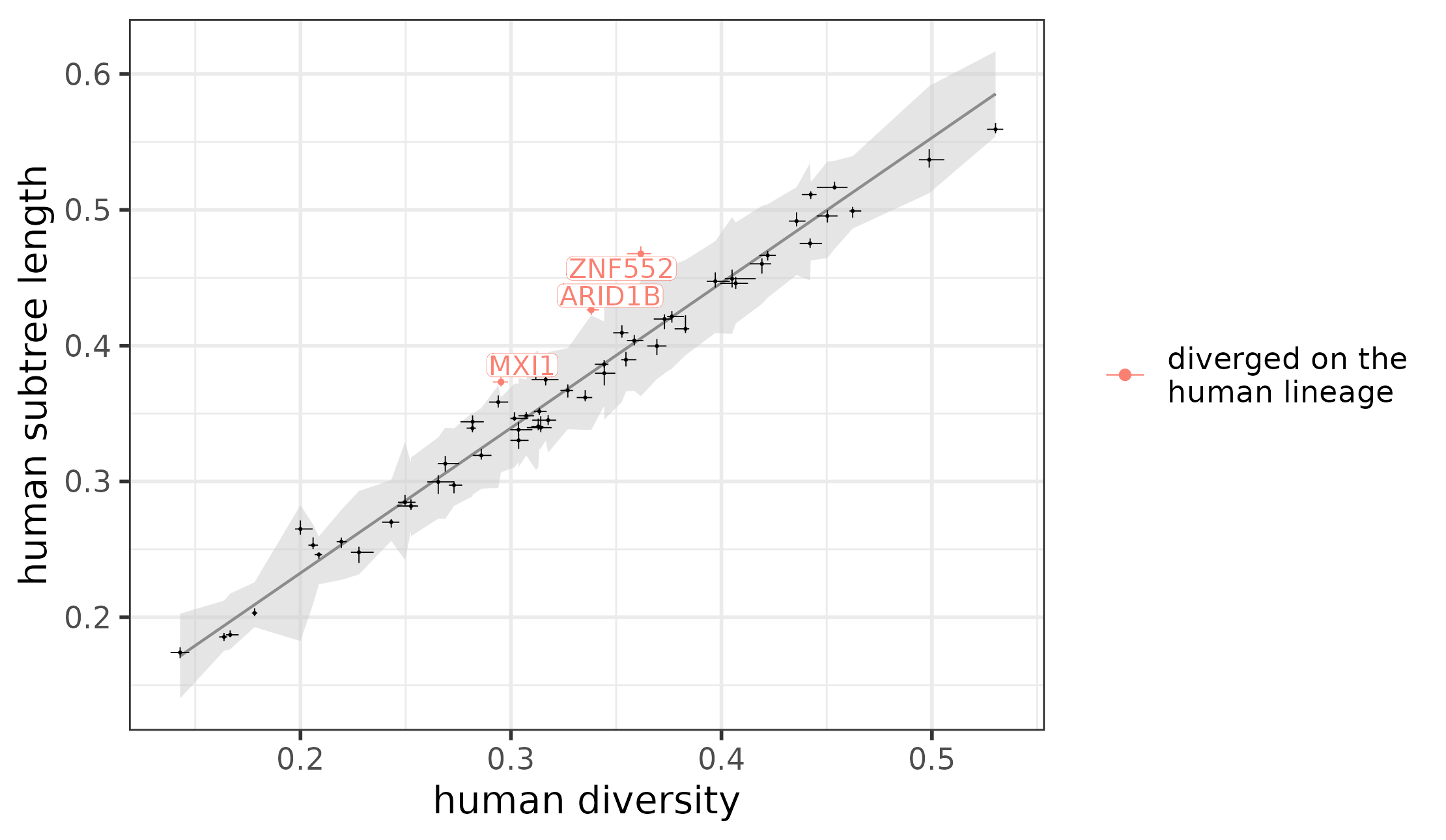
Weighted linear regression between the human subtree length and human diversity, with the diverged modules marked.
The distance matrices and tree reconstructions of the ZNF552, ARID1B and MXI1 modules can showcase in more detail what makes them diverged on the human lineage:
human_div_modules <- module_conservation_human %>%
  dplyr::filter(conservation == "diverged") %>%
  dplyr::pull(regulator) %>%
  as.character()
plotDistMats(dist[human_div_modules])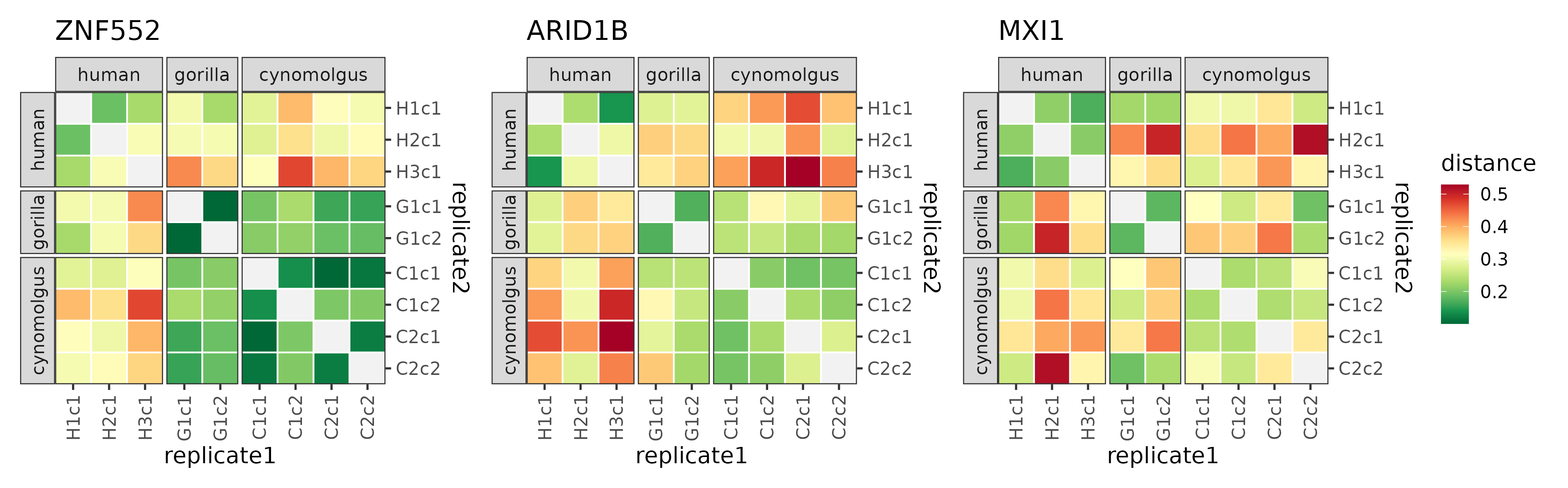
The distance matrices of the three modules that were found to be diverged on the human lineage.
plotTrees(trees[human_div_modules], species_colors = spec_colors)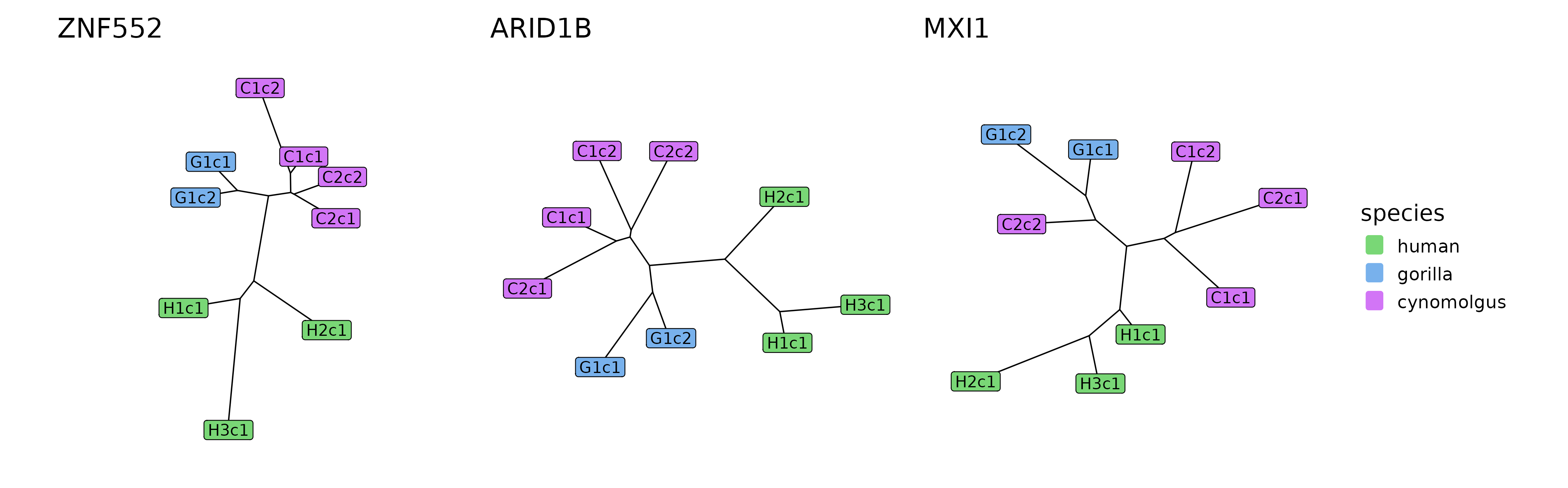
The tree reconstructions of the three modules that were found to be diverged on the human lineage.
The signal — unsurprisingly — is not as strong as in case of the modules diverged between cynomolgus and great apes, but it is still apparent that the human-gorilla and human-cynomolgus distance measures are higher than the rest. This also translates into a way longer human subtree length than expected based on the phylogeny and observed in most module trees.
Finding conserved and diverged target genes
Similar to the approach in case of the overall conservation and divergence, jackknifing can inform us about target genes that contribute the most to human-specific divergence. In this case, the residuals of the jackknifed module versions are calculated with regard to the regression model between the human subtree length and the human diversity. The target genes that result in the lowest residuals (i.e., the weakest signal of divergence) when removed are considered the most diverged in the original module.
We performed this analysis for the ARID1B module:
target_contributions_ARID1B <- findConservedDivergedTargets("ARID1B",
                                                           tree_stats_jk,
lm_human)| focus | regulator | type | id | gene_ removed | human_ diversity |
|---|---|---|---|---|---|
| human | ARID1B | orig | ARID1B_orig | NA | 0.336 |
| human | ARID1B | jk | ARID1B_jk_ACAT2 | ACAT2 | 0.332 |
| human | ARID1B | jk | ARID1B_jk_C12orf45 | C12orf45 | 0.336 |
| human | ARID1B | jk | ARID1B_jk_CHCHD2 | CHCHD2 | 0.305 |
| human_ subtree_length | fit | lwr_fit | upr_fit | residual | contribution |
|---|---|---|---|---|---|
| 0.428 | 0.378 | 0.335 | 0.420 | 0.050 | NA |
| 0.423 | 0.373 | 0.331 | 0.415 | 0.050 | 0.000 |
| 0.422 | 0.378 | 0.336 | 0.421 | 0.043 | 0.130 |
| 0.410 | 0.344 | 0.302 | 0.387 | 0.066 | -0.312 |
plotConservedDivergedTargets(target_contributions_ARID1B)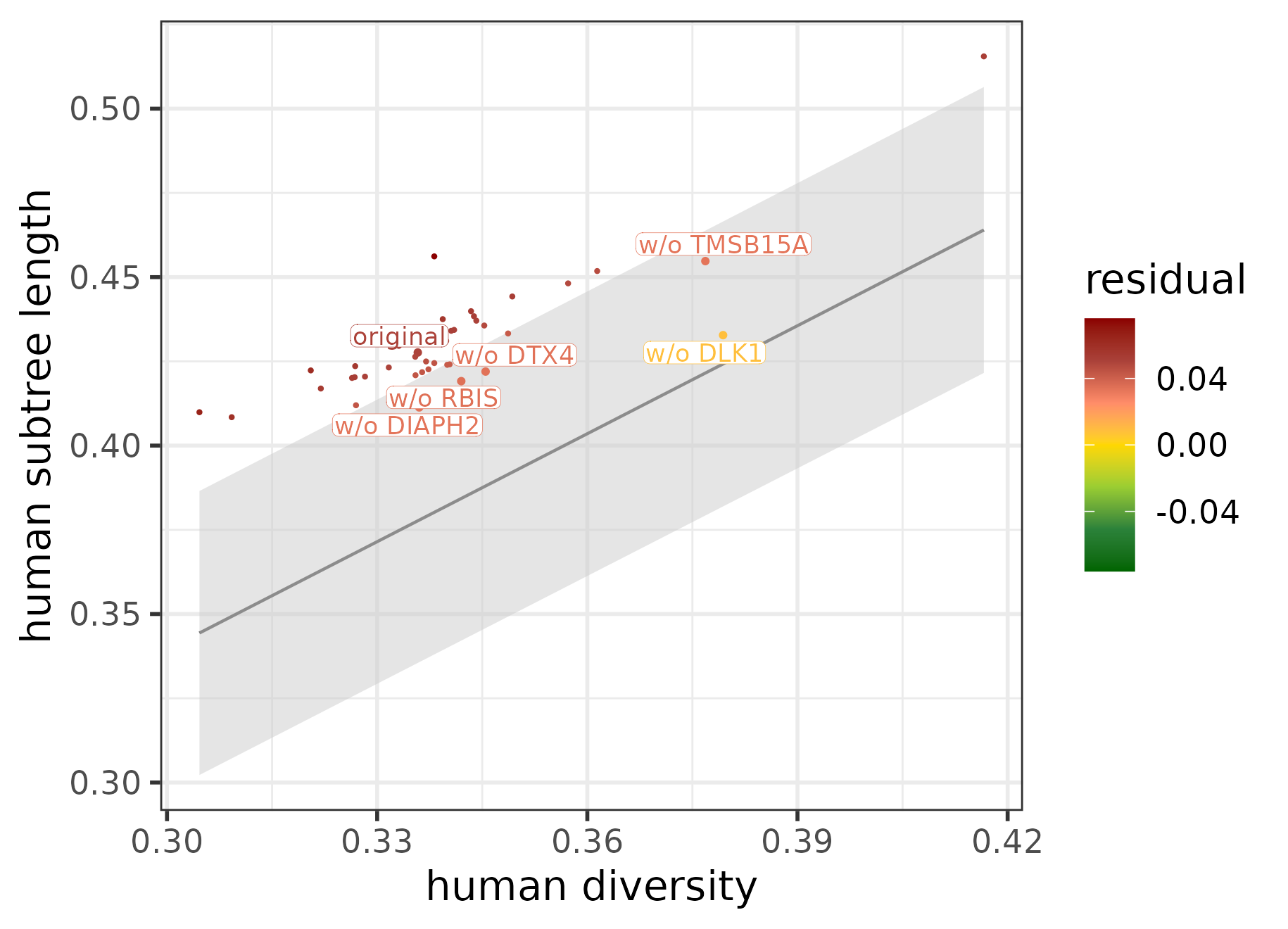
The top 5 most diverged target genes of ARID1B identified using tree-based statistics in combination with jackknifing.
top5_diverged_ARID1B_targets <- target_contributions_ARID1B %>%
  slice_min(order_by = residual, n = 5) %>%
  pull(gene_removed)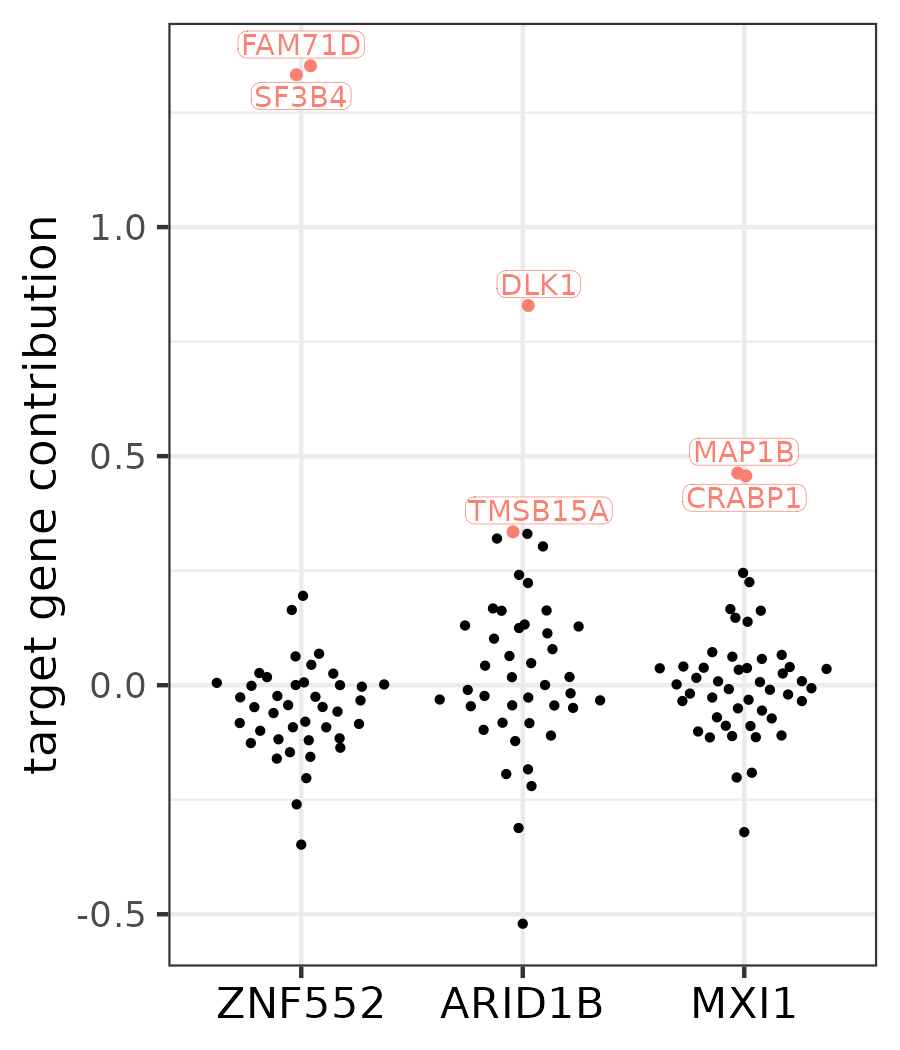
Contribution scores of the target genes in the three modules that were found to be diverged on the human lineage. The two top-contributing targets are labeled for each module.
plotExprAlongPseudotime(c("ARID1B", top5_diverged_ARID1B_targets),
                        sce,
                        species_colors = spec_colors,
                        cell_type_colors = ct_colors)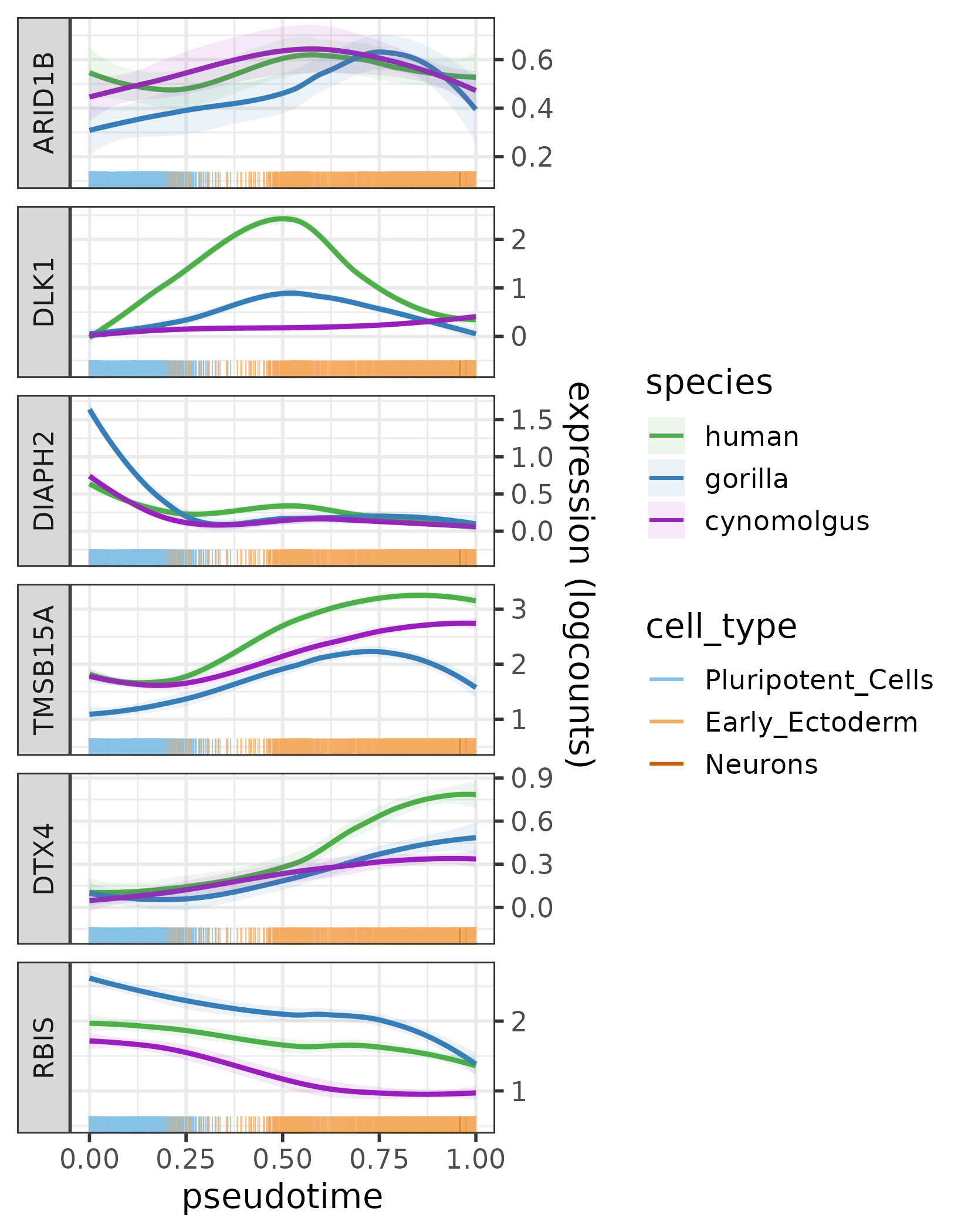
The expression profiles of ARID1B and its five most diverged target genes across the pseudotime trajectory per species.
Based on the effects of jackknifing, DLK1 proves to be by far the most diverged target gene of ARID1B. This is also reflected in its expression profile: it is upregulated much more in humans during the intermediate stage of the neural differentiation than in gorilla or cynomolgus.
Some other target genes of ARID1B also show slight human-specific differences in their expression patterns, e.g., TMSB15A and DTX4 are both upregulated the most in humans towards the late pseudotime stage.
Summary
CroCoNet provides a robust framework to quantitatively compare gene regulatory networks across species, while accounting for unwanted biological variation and technical noise. It defines joint co-expression modules across all species based on a phylogeny-aware consensus network and quantifies the conservation of these modules by contrasting cross-species and within-species topological differences. In addition, it can pinpoint individual target genes that contribute the most to conservation/divergence with the help of jackknifing. The modules and target genes detected as conserved or diverged are good candidates to explain cross-species differences and similarities in gene regulation and can be investigated in greater depth by follow-up analyses and experiments.